
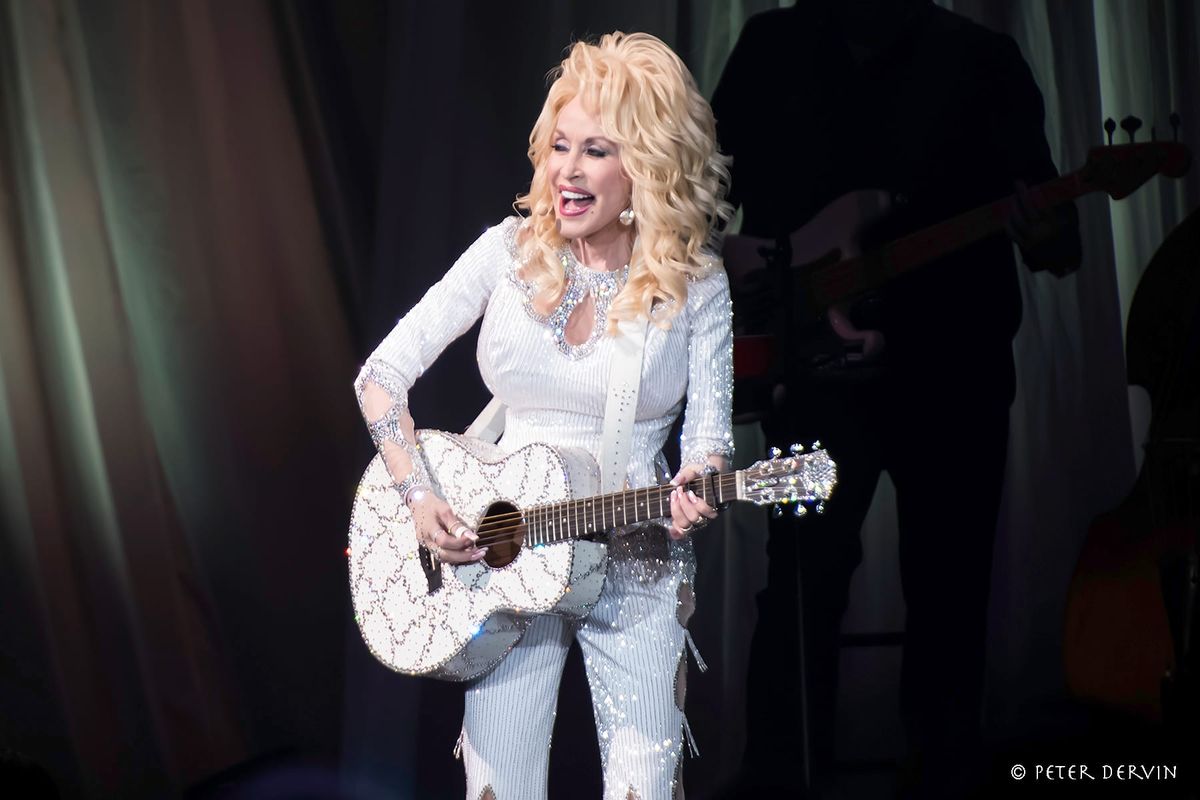
Born January 19, 1946, Dolly Parton was 80 years old. Not that years or linear time seem the right measure when talking about her. When I texted my friend (and former No Depression editor) Stacy Chandler, she replied, “I really thought Dolly was exempt from this.” Didn’t we all?
Dolly Parton was one of the most prolific, inimitable singers and songwriters of our times. She was capable of any form of musical expression — classic country, pop-country, folk, bluegrass, mainstream pop, an even disco, with collaborators as quirky as The Muppets and famous as Beyoncé. In a video that’s been recirculating on Instagram, we see her rapping on The Queen Latifah Show.
Speaking of videos, the camera loved Dolly, and not just because of her twin assets.
As a child of the ‘80s, I first encountered her on the screen. She was doing Julia Roberts’s hair — and dropping hilarious, deep wisdom — in Steel Magnolias. She was scene-stealing alongside two of the greatest actors/entertainers of her generation in 9 to 5. She was teaching a truck-driving, between-Rocky-sequels Sylvester Stallone how to be a fancy-pants cowboy in Rhinestone. Those three films barely begin to capture her range of talents.
She was also a could’ve-been billionaire who instead gave enormous amounts of her money to people who needed it more. Her Imagination Library has provided free books to millions of children. But there’s also the money Dolly gave to support the creation of a COVID vaccine. There’s the one thousand dollars a month, for six months, that she gave to each of nine hundred Gatlinburg, Tennessee, families whose lives were destroyed by wildfire. There’s the money she gave to high schoolers in Sevierville, Tennessee to buy their band uniforms and to encourage them to graduate.
Much of her philanthropy was not trumpeted. It wasn’t vanity. Dolly grew up in a rustic cabin in Lower Appalachia. She knew poverty, particularly childhood poverty. She also knew her worth and she used her music and celebrity to get enough to spread around. And she did more looking back at her childhood than looking down on it.
Dolly was loved by people of every race, religion, orientation, ethnic, partisan, and economic stripe because she understood we’re all just people — those who agree with one another as well as those who disagree. There but for fortune, the saying goes. And by believing and representing that truth so honestly, she taught us how to be just-people too.
After all, as much as we may have wished she’d be spared her own mortality, Dolly was just a person too. She was funny and tough and sweet and smarter than all of us. She had dreams and fears and hope and heartbreak, and she taught us how to encounter the same, across her exhaustive musical catalog.
A symbol that came to be associated with her was the butterfly — a fitting metaphor for her extraordinariness. Butterflies are beautiful, of course. They’re colorful and kind of silly in the way they flit around instead of flying anywhere in a straight line. But butterflies don’t suffer fools.
Butterflies eat a lot of shit. They only get to metamorphose after their caterpillar starter bodies dissolve into a well-hidden goo, inside a sac of their own making. They appear weightless, impossible embodiments of whimsy, persisting through a much more mundane and punishing world.
With their stick-figure-drawing legs, they can stand on your shoulder and you won’t feel it, but you’ll know it somehow. You’d be hard-pressed to find a human who doesn’t delight in the sight of a butterfly. Same for Dolly.
I only got to see her in concert once, on August 8, 2008. She was in Seattle on her Backwoods Barbie tour, stopping at the WaMu Theater. It was a ridiculous venue for a woman who started her life in a rustic cabin a few mountain ranges away. Black metal chairs, maybe acquired at Staples, were placed in careful lines in the middle of the room. Row after row on one flat cement floor in what felt like a warehouse.
But Dolly, then 62 years old, performed for three hours straight, like it was nothing. Like this was her living room and every one of us had just come by for a beer. There were tall tales, that old tradition from those very old mountains that began her. There were jokes, always. (“People like to ask me how long it takes to do my hair. And I like to tell them I don’t know. I’m never there!”) And laughter.
The writer Anne Lamott likes to say that laughter is carbonated holiness. I always thought she must have come up with that line after hearing Dolly giggle.
And of course there was music, in her trademark lonesome soprano that was equal parts laughter and strife. Every instrument Dolly played that night was blanketed with rhinestones. How on earth could she fret a guitar with her long-nailed fingertips? Yet, she was a masterful player on guitar, fiddle, keys, even a delightfully bedazzled autoharp.
She tore through her decades-long catalog from tunes she’d sung with Porter Wagoner to her more recent bluegrass.
I was there as a fan, not a reporter, so I don’t have a record of the set list. But I’m sure it was a tour of her vast, diverse catalog. From “He’s Alive” to “Two Doors Down.” From “Baby I’m Burnin’” to “Little Sparrow.” From “The Last Thing on My Mind” with Porter to “Islands in the Stream” with Kenny Rogers to “Wrecking Ball” with Miley Cyrus. The songs she sang as Trio, with Emmylou Harris and Linda Ronstadt. And of course, nobody — including Dolly — could ever forget what Whitney Houston did with “I Will Always Love You.” Elvis Presley wanted it first, but Dolly wouldn’t give up half the publishing rights. Plus, she knew it wasn’t his song to sing, and she was no dumb blonde. (“I know I’m not dumb. I also know I’m not blonde,” she would say.)
When she got to “Coat of Many Colors,” the woman next to me was visibly emotional. I noticed her wipe a tear from her face during the intro, and then by the first chorus, she was beside herself, sobbing. Her friend held her. This simple lyric, wherein Dolly paid tribute to her own mother from long ago and far away, was having the very real-time effect of exorcising old pain from a total stranger’s nervous system.
Good lord, there was nobody like Dolly.
Nine years ago, at this very publication, I had the pleasure of editing Sarah Smarsh’s four-part series on Dolly Parton, She Come by It Natural (ND feature). It later became a book by the same title and, if you’re looking to linger a while in Dolly Parton’s America, I cannot recommend it enough. Dolly Parton’s America is also a podcast well worth some hours (ND feature). Not that there’s any shortage of legacy to keep Dolly in our hearts forever.
She is survived by a sizable number of nieces, nephews, siblings, and cousins. Also by her goddaughter Miley Cyrus and a parade of other women artists, not limited to Sabrina Carpenter, Beyoncé, Taylor Swift, Brandi Carlile, Maggie Rogers, and Amanda Shires, who owe her a lifetime of thanks. She leaves behind two Broadway musicals, 16 movies, 58 music albums, and more than 3,000 songs.
Comments ()