Editor's note: In honor of Dolly Parton passing away this week at the age of 80, we're revisiting some of No Depression's best stories about the "Queen of Country." This excerpt comes from the first installment in a four-part series by No Depression's first Writing Fellow, Sarah Smarsh, who went on to publish this work as the book She Come By It Natural: Dolly Parton and the Women Who Lived Her Songs, which came out in 2020. Her original submissions were published throughout 2017 and are available in No Depression's archives here.
In my family, country music was foremost a language among women. It’s how we talked to each other in a place where feelings weren’t discussed.
“Listen to the words,” Mom used to say, and the song on her record player, 8-track, or tape deck would convey some message about life, about men, about surviving. The voices belonged to Wynonna and Naomi Judd, K.T. Oslin, Janie Fricke, Lorrie Morgan, Anne Murray, and of course to Dolly, Tammy, Patsy, and Loretta. But the information passed from my mother to me, if only because she was connecting to those songs herself and I was there to hear them. I recall Reba’s hit “Little Rock” — not about a town in Arkansas but about slipping a ring off one’s finger — being on heavy rotation in our living room not long before my mom divorced my dad.
That I can map my upbringing against a soundtrack of declarative statements sung by women in denim and big hair is one of my greatest blessings, I often think. We weren’t a family of musicians, but the two women who raised me, my mom and grandma, cared a great deal about music that validated the stories of our lives — working-class girls, women, wives, mothers — in a way that TV shows, movies, books, magazines, and newspapers almost never did.
In the 1980s, when small prairie towns around us were dwindling with economic blight, living in the country meant frequent drives “to town” to buy this or that item or, say, to work at the Wichita mall over the holidays as my mom sometimes did for extra cash. That made for a lot of highway time, and instead of talking to each other, Mom and I both faced forward and sang the same words at the same time — country music, usually by women, filling the spaces of silence rolling along flat Kansas landscapes. Mom’s cigarette smoke streamed out her cracked window while she held the steering wheel and tapped the air with one of her long, red fingernails.
One song we wore out on a tape together happens to be about women indirectly communicating with each other: “Letter Home,” by the Forester Sisters, from their 1988 album, Sincerely. The lyrics are in the voice of a 29-year-old woman writing to tell her mom that her marriage is over.
One day when I was grown, it came on and we were delighted to find we both remembered all the words. Mom went quiet and listened at this verse in particular, though, like she was hearing it in a new way — now as the mother. And indeed at that moment I was the recently divorced, 30-ish daughter.
Jimmy found somebody else —
He told me that on New Year’s Day.
He said he felt like a man with her,
And I watched them drive away.
Children and rent:
There was no time for tears,
Just time to carry on.
I didn’t know how to tell you,
So there was no letter home.
Suddenly incredulous, Mom spoke. “He ‘felt like a man with her, and I watched them drive away’?” she said. “How do you feel with this boot up your ass?”
We laughed so hard we doubled over. Neither of us needed to point out that every woman we knew, ourselves included, had only ever done the leaving, not the being left.
Mom stopped laughing again at the next verse, though.
I work in a place with
some other girls,
And we’re all doin’ alright.
We raise our kids,
and our jeans still fit,
And sometimes we go out at night.
I’m 29 years young today,
And I’ve lived it to the bone.
And I just wanted to send you
This letter home.
“Our jeans still fit,” Mom said quietly and stared into the distance. “Yep.” She slowly nodded her head, her smile gone and one eyebrow lifted in knowing.
What she knew was that the shape of a working-class woman’s body has a lot to do with her survival. Not so much because she wants to “catch a man” — the men she has occasion to meet are broke, too, and don’t think she doesn’t know it — but because the significance of the female form as an object in society is one of the few powers she possesses. Unlike expensive college degrees and high-status material possessions, her body is hers, and how it looks will affect the economic course of her life: whether she looks nice enough to get the job at the makeup counter; whether the UPS manager, frowning that she’s too small to do the work, can be convinced with a smile in the interview; whether the banker will approve the shaky loan.
(As it happens, the Forester Sisters’ 1991 single “Men,” which humorously paints a grim picture of the male gender, has been ironically used by Rush Limbaugh to set up his talk show’s recurring “feminist update,” which often derides women for their appearance.)
The physical stakes for the working-class woman go beyond those sexual undertones, even, to a matter of simple respect. Poor women are lampooned in popular culture as overweight, having bad teeth, bad clothes. All those signifiers of health and appearance — which of course are signifiers of class — affect every interaction in a woman’s day. For the woman with no money in the bank, each of those interactions decides her and her family’s survival.
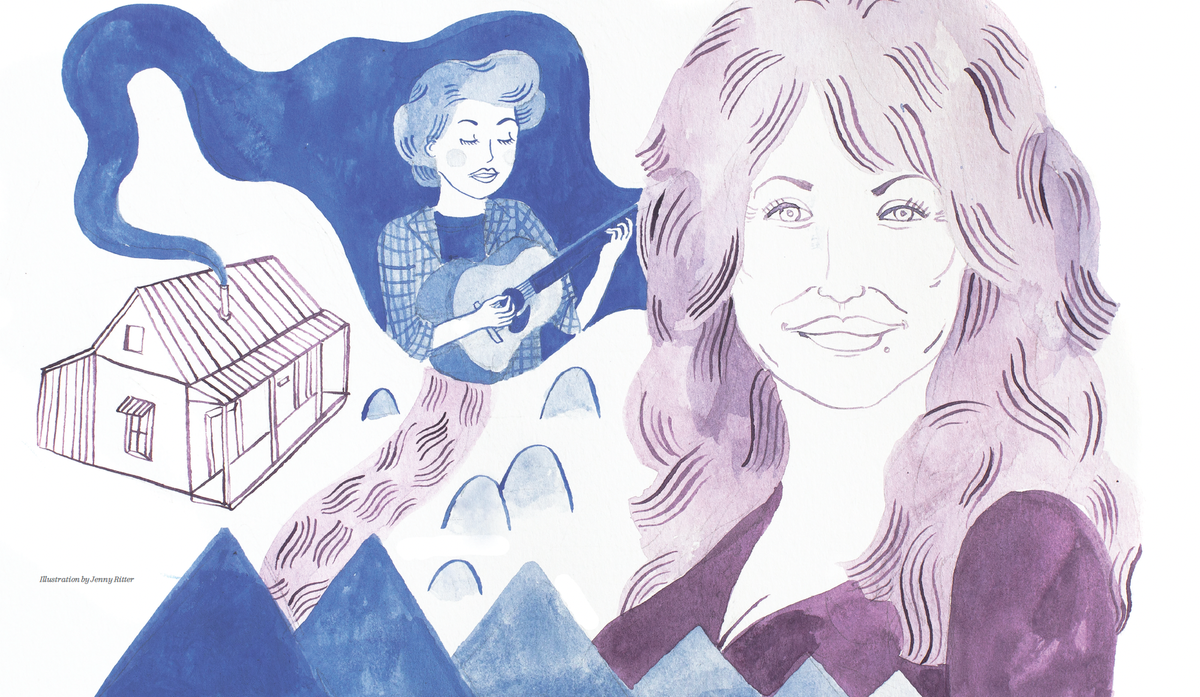
One woman who understands that, of course, is Dolly Parton.
Parton’s musical genius deserves a discussion far beyond and above the matters of gender and class. But the lyrics she wrote are forever tied to the body that sung them, her success forever tied to her having patterned her look after the “town trollop” of her native holler. For doing so, she received a fame laced with ridicule; during interviews in the 1970s and ’80s, both Barbara Walters and Oprah Winfrey asked her to stand up so they could point out, incredulously and without humor, that she looked like a tramp.
Meanwhile, Johnny Cash famously wore black as a statement of rebellion against the status quo and on behalf of the downtrodden and was lauded for it. But that’s the difference between being a man and a woman singing country-western music, or doing just about anything else.
The women who most deeply understand what Parton has been up to for half a century are the ones who don’t have a voice, a platform, or a college education to articulate it. This too is a source of affection between Parton and some factions of her audience, perhaps — a secret that not one of hundreds, maybe thousands, of interviews has revealed, because people who make a living as writers and critics don’t even know to ask the question: What role has Dolly Parton’s music, movie roles, and persona played in the lives of economically disenfranchised women used to being shamed or cast as victims?
That question has a lot of correct answers, but one of them is this: At age 70, Dolly Parton produced a Christmas movie in which a shooed-away hooker returns at the end to help a little girl, and she cast herself to play the role.
It’s widely discussed that Parton never forgot her roots, never left behind her community — the economy of which now revolves around her tourist attractions, the children of which receive books and scholarships her foundation provides, the recently incinerated homes of which will be rebuilt with her help. Less has been said about the extent to which she never left behind a certain archetype of American woman, the one whose trailer leads the world to deem her “trash.” She isn’t necessarily white, but she is necessarily poor, and she most definitely didn’t get to study feminist theory in a college classroom.