
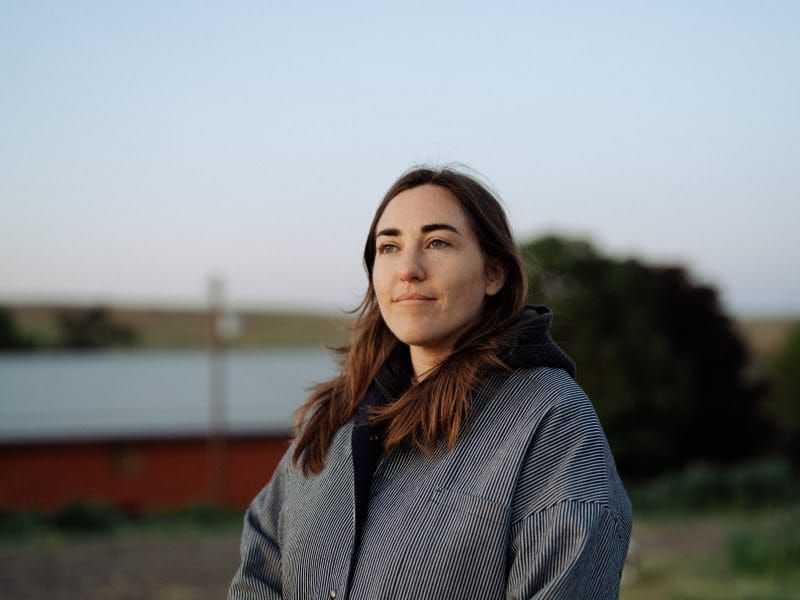
There comes a time in the journey of many singer-songwriters when they find themselves drawn to Texas. “Choosin’ Texas,” this is not. It’s chasing the ghosts of its famous (and sometimes infamous) songwriters — Guy Clark, Townes Van Zandt, Joe Ely, Doug Sahm, and a myriad of others. It’s the urge to experience the same wide-open spaces and lonesome landscapes that Willie and Waylon romanticized and the venerated clubs that brought together the hippies and the rednecks over Lone Star beers and country music.
Margo Cilker’s own identity as a songwriter, at least on her first two full-length albums, has been deeply intertwined with the Pacific Northwest she calls home. Yet, she was ready to change things up for her third effort, Little White Cross, out tomorrow via Fossil Records. Texas beckoned her and, like so many songwriters before, she heeded the call.
“I'm not a Texan, but there's something so comforting about being in a place where something happens, and you can be like, ‘Hey, it's just like that one line in that James McMurtry tune, and nobody looks at you funny.’ We all know who he is! There's a common understanding about certain musical touchstones,” says Cilker before adding that she went even deeper into the Lone Star State’s musical heritage. “I basically went down The Flatlanders rabbit hole at some point before making this record — Joe Ely, Butch Hancock, Jimmy Dale Gilmore, all of them just really resonated with me and really kind of saved my inspiration for music from like whatever precipice it was dangling off of.”
Her first two full-length albums, 2021’s Pohorylle and 2023’s Valley Of Heart's Delight (ND review), drew comparisons to artists like Lucinda Williams and Gillian Welch for their thoughtful storytelling. She maintained a relentless touring schedule that brought her around the world from saloons and dive bars to big stages and even the beloved National Cowboy Poetry Gathering in Elko, Nevada that she attends every year with her husband, bandmate, and fellow songwriter Forrest VanTuyl. Even with such successes, she found her authentic, humble pursuit of art up against the headwinds of a rapidly changing industry plagued by AI and algorithms, declining concert attendance, and rising touring costs. When the dust settled, Cilker felt creatively spent and found motivation in Texas songwriters.
“Those [Texas songwriters] definitely reeled me back in when I was feeling like, “What is going on with the current state of affairs in this industry?” You got these guys just trucking along for 50 years. They never thought twice; just do your work, keep your head down, write songs, give them to your friends. Pass them around,” reflects Cilker.
One of those Texas songwriters was Bruce Robison, whose poignant ballad “Travelin Soldier” (famously recorded by The Chicks), was a longtime favorite of Cilker's. Robison carved out a name for himself as a producer working with an esteemed list of country and roots music acts like Charley Crockett, Kelly Willis, and Flatland Cavalry. Robison became a fan of Cilker’s, catching her shows whenever she cruised through Austin.
“I was working on some songs, but I could sense that whatever project was coming next was going to be a little bit different. Bruce's recording style and getting out of the Northwest were both very alluring prospects to me at that time,” she says.
Conversations with Robison soon evolved into Cilker making her way to The Bunker, his studio in Lockhart, Texas, a quaint town known more for barbecue than music that, in recent years, has become a place of exodus for artists fleeing the exorbitant costs of nearby Austin. Instead of working with her longtime collaborators in Oregon and Washington, Cilker and Robison brought in a wrecking crew of Texas talent that included pedal steel player Eric Heywood, guitarist Geoff Queen (Hayes Carll), fiddler Beth Chrisman (John C. Reilly), drummer Lisa Pankratz (Dave Alvin), bassist Scott Davis (Band of Heathens), and more.
Cilker didn’t suddenly turn around and make a Texas country album, but working in this environment gave her something she was seeking. As she recalls, “It was like I needed an emotional pivot almost. I could have easily called up the same cast of characters, and we could have happily made another album. You get older, and you just get new problems, and you have to find new solutions to those problems.”


![SPOTLIGHT: Reflections On The Inevitable Folly Of Naming Things, Or Whatever [ESSAY]](https://storage.ghost.io/c/18/d0/18d08e58-3b1b-4720-ae25-a31b44e69d4b/content/images/size/w720/2026/09/Jude-Brothers-Spotlight-Photo.png)