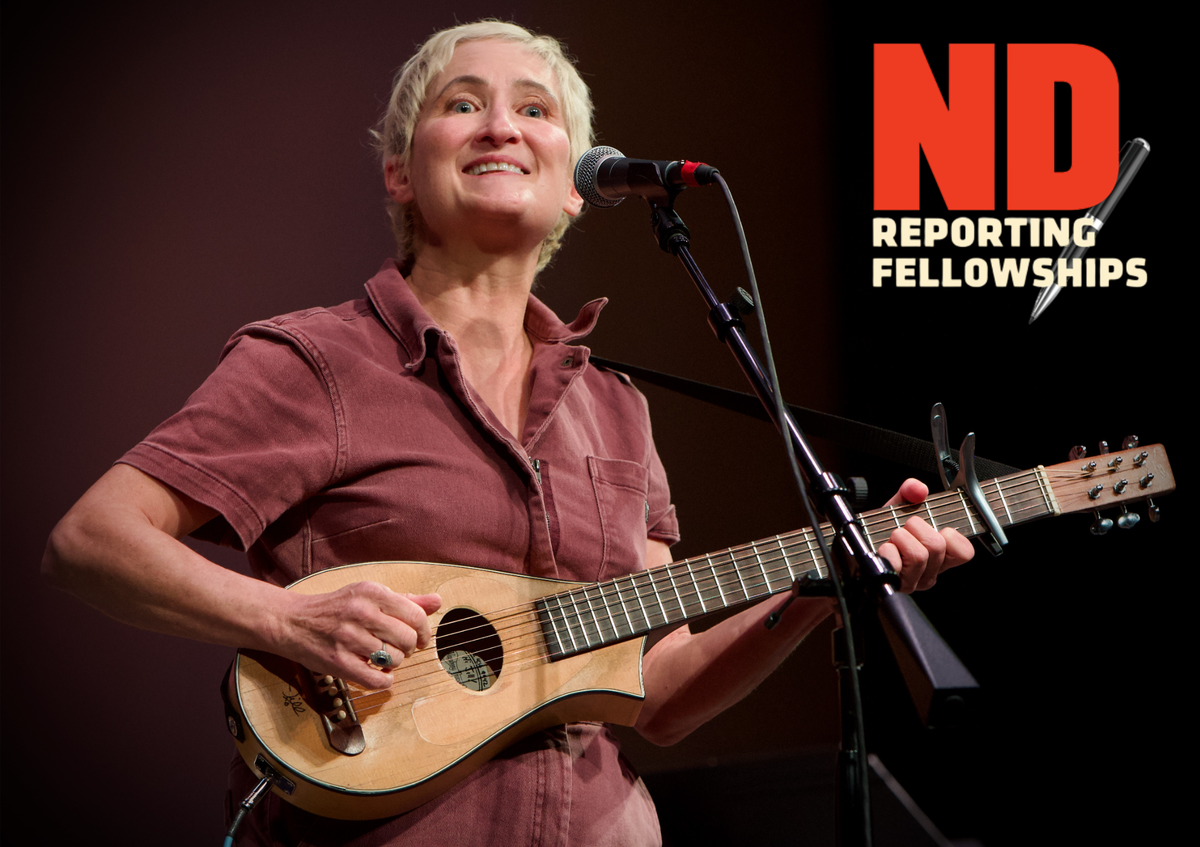
Editor's Note: David Hajdu has been awarded one of two No Depression Reporting Fellowships to write four in-depth features on a topic deeply impacting roots music today. His begins today with a multi-perspective profile of singer-songwriter Jill Sobule — part biography, part co-written memoir, and part tribute. Stay tuned for more from both No Depression Reporting Fellows throughout the rest of the year and into 2027.
She said, “Hey.” That was all.
The message popped up on the cute little screen of my new iPhone 4, and I knew who had sent it before a second text with actual content arrived about 10 minutes later. Jill Sobule always texted me that way, just saying "Hey" and disappearing – briefly, usually, but sometimes for a few hours, occasionally a day or two. It was October 22, 2010. The lingua franca of texting was just taking shape, and the technology still seemed novel and fun. Jill was the only person to lob out a one-word "Hey" in my friend group. I thought this was a secret code between the two of us. It hadn't occurred to me that millions of first-generation texters were simultaneously innovating a new rhetoric of generic monosyllabic greetings. Nor did I realize at the time that Jill, a multi-tasker disinclined to focus on any one activity or any one person for long, was probably texting a dozen other people at the same time – while watching TV, playing a word game, reading a magazine, and writing a song.
She would be giving a concert that evening at the Rubin Museum, a swanky treasury of Himalayan art in the Chelsea district of Manhattan, and she wanted to know if I was planning to go. It would be a nice, intimate event in the museum's small auditorium, she said – a solo acoustic performance with no microphones. Only Jill and her guitar.
Or someone's guitar. She had just arrived in New York after playing a gig a few nights earlier in Cambridge, Massachusetts, and she had left her guitar with a friend she had stayed with there. If I would be going to the Rubin, would I bring my guitar, so she could play it in the show?
With a few hours to go before her start time at 7pm, we worked out a plan. My instrument, an old Gibson archtop jazz guitar, would not project loudly enough for the purpose. But my friend James Marcus, an editor at Harper's with whom I sometimes played music for pleasure, had a Martin dreadnaught with a big, rich sound. I gave him a call, and he said he would be happy to bring it to the Rubin for Jill to use, and he would stay for the show. All would be well.
A few greats before her had done such things. Charlie Parker, the epoch-changing jazz saxophonist, was notorious for showing up at gigs with no instrument, having pawned his alto sax for cash to satisfy his heroin habit. Djanjo Reinhardt, the titan of "gypsy" jazz, was known for traveling around Europe without his guitar, playing whatever instruments his hosts provided. He once arrived in the United States from Paris to perform with the Duke Ellington Orchestra at Carnegie Hall and had no guitar in hand. Hubert Sumlin, the bluesman, once left his Rickenbacker Capri electric guitar in a taxi and had to play an instrument Stevie Ray Vaughn gave him until Vaughn tracked down the cab driver and had Sumlin's guitar returned.
Jill never suffered the curse of drug addiction. Nor was she Roma or a bluesman, though there were strains of wanderlust, a free-spiritedness, and a refusal to conform to the rules of proper society in Sobule that made her a modern-era inheritor to the traditions of vagabond troubadours like Reinhardt and itinerant workhorses like Sumlin, and she was certainly capable of getting distracted enough to leave something valuable in a cab.
At the Rubin Museum that night, Jill was loose, confident, self-effacing, and deceptively lighthearted. As always, the apparent offhandedness and bounciness of her music disguised its depth and complexity. She was layered in chic bohemian black, like a good number of her songs, dressed in a sleeveless black mini dress with a lacy V-neck, black opaque fishnet hose, and black leather boots strapped with big buckles. Her blonde hair was cut in a jagged, uneven bob, as if a second stylist had come along with giant sheers to mess up the first stylist's work. Playing that borrowed acoustic guitar with no strap, she sat on the edge of the stage, just inches from the front row of the audience. If she had swung one of her legs to the beat of a song, she would have kicked a fan in the knee.
Chatting casually between songs, Jill made the concert more like an hour spent at home with a close friend who happens to write lacerating songs. The venue, she explained, was for many years the site of Barney's, the upscale department store, where Jill herself had worked as a shoe salesperson decades earlier, when she had first moved to New York from her native Denver. One day, she had helped Barbra Streisand try on pumps. Barney's was the store she was talking about in "Karen by Night," a story song on her 1995 self-titled sophomore album, in which Jill imagined that her boss, the straight-laced shoe-department manager Karen, had a secret life as a leather-clad biker chick smuggling contraband. Set to a chunky syncopated rhythm, the song has a catchy melody that Jill delivered in a sweet, girlish voice that, like the Karen character in the song, had hidden depth, a darker character bubbling under a cheery surface. This quality of duality – presenting cheerfully, unthreateningly, while holding deeper, graver meaning – is the essence of her art. It makes her music easy to enjoy and equally easy to misunderstand and under-estimate.
Staying seated at the edge of the stage for most of the show, Jill sang a dozen new or recent songs, some so fresh that she had to read the lyrics from a notebook laid on the floor beside her. She did "The Rapture," a faux celebration of the end of days; "A Good Life," a more positive spin on the approach of the apocalypse; and "I Swear I Saw Christopher Reeve," a song the two of us had recently written for a concept album we were planned to put out together. She sang "October in Paris," a bleak travelogue with a merry-go-round melody, in three-quarter time:
October in Paris, the skies are all gray
I walk all alone on the Champs Elysees
It just reminds me of those German tanks
tolling through the arches
The more I travel, the more I unravel
And travel she did. By the second decade of the 21st century, Sobule had no permanent home, crashing with friends and fans around the country as she played house parties, small clubs, and the occasional mid-sized theater. When she was in New York, she stayed often with my wife and me, sleeping on the fold-out couch in our apartment in Morningside Heights. She was visiting friends in suburban Minnesota between gigs when the house caught fire and she died in bed on May 1, 2025.
That night at the Rubin, though, she sang one more tune she had written recently, "While You Were Sleeping" – a gently lilting ballad about being blindsided by sudden, unexpected events:
While you were sleeping
everything changed
Fashions are strange, the sunlight is blinding
While you were sleeping
everything changed