Editor's Note: Santi Elijah Holley has been awarded one of two No Depression Reporting Fellowships to write four in-depth features on a topic deeply impacting roots music today. Read his first chapter, which introduces spirituals as a foundational form of American roots music, here, and stay tuned for more from both No Depression Reporting Fellows throughout the rest of the year and into 2027.
When the Civil War ended in 1865, four million Black men, women, and children who had only known perpetual servitude found themselves miraculously freed. Since being brought in chains to America in 1619, Africans had been considered by enslavers as little less than subhuman, nothing more than property — to be bought, sold, driven, beaten, and massacred at will. The descendants of those first Africans to arrive in Virginia had inherited the loss, shame, and grief of their parents, grandparents, and great-grandparents, wondering to themselves if their miseries would ever end. Black people had existed in America for nearly 250 years under the constant threat of kidnapping and permanent subjugation, with few legal protections. With the ratification of the 13th Amendment on December 6, 1865, involuntary servitude became prohibited by law, followed in 1868 by the 14th Amendment, granting citizenship to Black people born in the United States of America, and equal protection under the law. Black people in this country were no longer strangers in a strange land; they were now US citizens.
From the earliest slave songs to the advent of the spirituals, Africans in America had prayed, shouted, composed and sang songs in hope and anticipation of the day God would deliver them and bring about their emancipation. And at long last, that day had arrived.
“To most of the four million black folk emancipated by civil war, God was real,” wrote scholar W.E.B. Du Bois in his 1935 book, Black Reconstruction. “They knew Him. They had met Him personally in many a wild orgy of religious frenzy, or in the black stillness of the night. His plan for them was clear; they were to suffer and be degraded, and then afterwards by Divine edict, raised to manhood and power; and so on January 1, 1863, He made them free.”
Du Bois was referencing the date when President Abraham Lincoln signed the Emancipation Proclamation, freeing only the slaves held in Confederate states. Indeed, the “four million black folk” were not all freed in one go. During the war, tens of thousands of slaves fled from plantations across Union lines and were granted their freedom, with many of the former slaves living in “contraband camps.” Nearly 250,000 slaves in Galveston, Texas hadn’t learned of their emancipation until June 19, 1865 — a day now celebrated as the Juneteenth national holiday. With the Union victory and the effective end of slavery in America, Black believers would credit their liberation to their unbending trust and faith in God. Like the Israelites they sang about in their songs and spirituals, Black people in America had now, too, been liberated from bondage. God had not forgotten them.
“For the slaves in the South, the end of the Civil War meant that as they had believed and sung all along, God had intervened on their behalf,” wrote scholar Robert Darden in his 2014 book, Nothing but Love in God’s Water. “Through their unwavering faith, their spirituals, and their prayers, they had played an active part in their own deliverance.”
Where such spirituals as “Go Down Moses,” “Follow the Drinking Gourd,” and “Steal Away” were said to have assisted slaves on their escape to freedom, by providing coded instructions and directions, other songs and hymns like “The Old Ship of Zion,” “Didn’t My Lord Deliver Daniel?” and “Swing Low, Sweet Chariot” offered the slave the promise of a brighter day — either in this world or the world to come — when he would be freed forever from captivity. But now the slaves had been lawfully emancipated, with no need for cryptic meanings and messages, and the promise of freedom had been fulfilled. Of what benefit were spirituals to the newly emancipated Black Americans?
By the end of the 19th century, spirituals were already being viewed by many Black Americans as an anachronism — a painful reminder of slavery, which had only recently been dissolved. “First generation” Blacks — the children born of former slaves after Emancipation — regarded spirituals with contempt and ridicule. They couldn’t relate to these enigmatic, mournful songs. They couldn’t understand why their parents and grandparents would stand around and sing about Jesus on Calvary and Moses in Egypt and Daniel in the lions’ den, when they had been facing hell right here on the plantation. While the older folks credited the end of slavery to God and His infinite mercy, the younger folks wondered why God had taken so damn long.
But it wasn’t only Northern congregations that had discarded the spirituals. Southern churches and church leaders, too, were now turning their noses up at such “primitive” music. The prominent clergyman and abolitionist David Alexander Payne — sixth bishop of the African Methodist Episcopal Church (AME) who, upon assuming the presidency of Wilberforce University, became the country’s first Black college president — was an outspoken critic of spirituals and ring shouts, or what he derided as “corn-field ditties.” In his 1888 memoirs, he recalls visiting a “bush meeting” 10 years earlier, upon the invitation of its pastor. Payne was scandalized by what he’d witnessed:
After the sermon they formed a ring, and with coats off sung, clapped their hands and stamped their feet in a most ridiculous and heathenish way. I requested the pastor to go and stop their dancing. At his request they stopped their dancing and clapping of hands, but remained singing and rocking their bodies to and fro. This they did for about fifteen minutes. I then went, and taking their leader by the arm requested him to desist and to sit down and sing in a rational manner. I told him also that it was a heathenish way to worship and disgraceful to themselves, the race, and the Christian name. In that instance they broke up their ring; but would not sit down, and walked sullenly away.
What had been the singing and dancing tradition of enslaved Africans in America, which they had developed and nurtured and protected for centuries — the songs they had risked their own lives to sing — were now seen by many of their descendants as aberrant, embarrassing, and improper. The music that had come to be known as spirituals may have become summarily discarded and extinct before the arrival of the 20th century, if not for an ensemble of college students at Fisk University.
The Fisk Jubilee Singers
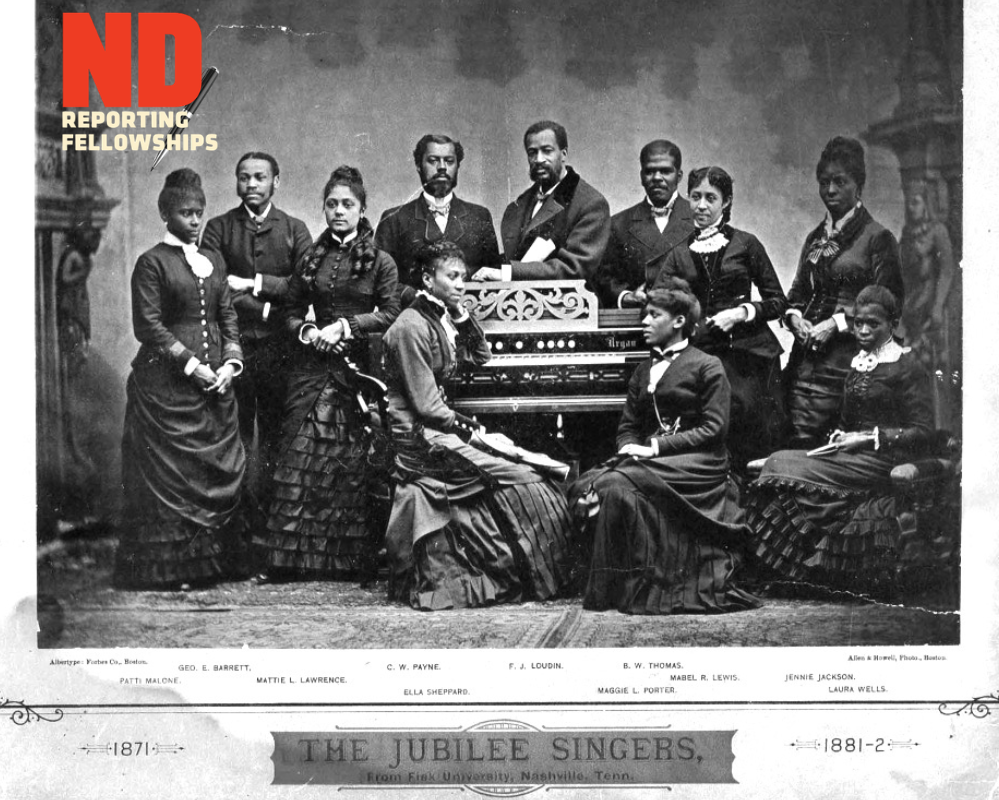
Opened in Nashville, Tennessee in 1866, Fisk University was founded by the American Missionary Association, to provide higher education to young or recently freed Black Americans, but it was soon beset by financial difficulties. Within five years, Fisk was under threat of bankruptcy and closure. University treasurer and music teacher, George Leonard White, recognized that some of the students were talented singers and saw an opportunity to help raise desperately needed funds. White enlisted nine students — five women and four men — for a yet-unnamed choir, with the goal of raising $20,000 for the struggling university. Early performances, at college halls and conventions, received mixed reviews and meager donations. On October 6, 1871, the choir left Nashville on a fundraising tour of the United States and, after much praying and debating, White arrived at an official name for the ensemble, The Jubilee Singers. The name was in reference to the biblical “Year of Jubilee,” from Leviticus 25, when all slaves were commanded by God to be set free.
The Jubilee Singers (they wouldn’t be referred to as the Fisk Jubilee Singers until years later) soon found more receptive and giving audiences, especially after a New York performance hosted by prominent abolitionist and minister Henry Ward Beecher, who lauded the singers and encouraged his parishioners to donate abundantly. A performance at Brooklyn’s Lafayette Avenue Presbyterian Church inspired another abolitionist and minister, Theodore Ledyard Cuyler, to extoll the choir, in the pages of the New York Tribune, as “the genuine soul-music of the slave cabins.”
The music first performed by the Jubilee Singers, however, was a far cry from the music of the slave cabins and plantations. Early setlists mainly comprised parlor songs, temperance songs, and other such sentimental ballads as “Home Sweet Home” and “Old Folks at Home” (also known as “Swanee River”). Spirituals were performed only intermittently and often reluctantly by the singers. But when they saw how the spirituals garnered the greatest and most enthusiastic response from the audience, these songs took center stage.
The predominately White, liberal, northern audiences were enraptured by what they viewed as authentic slave songs and spirituals, performed by “genuine Negroes,” as opposed to the blackface minstrelsy that had gained in popularity since the end of the Civil War. By early 1872, the Jubilee Singers’ repertoire included such spirituals as “Swing Low, Sweet Chariot,” “Roll, Jordan, Roll,” “Steal Away to Jesus,” and the fabled “Go Down, Moses.”