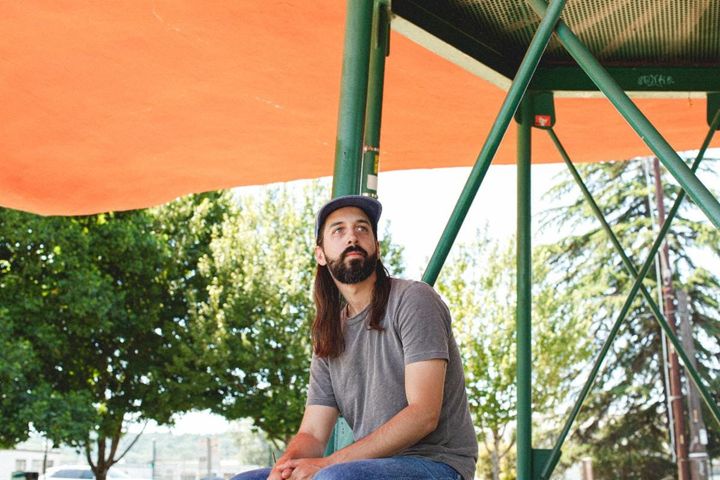
Kristian Matsson has been The Tallest Man On Earth, or at least performing as such, for 20 years now. He’s mined sparse, acoustic folk (like on his debut LP, 2008’s Shallow Grave and the aching heartbreak of 2019’s I Love You, It’s A Fever Dream) and explored complex, rockier iterations (like his first forays into electric guitarwork on 2010’s EP Sometimes the Blues Is Just a Passing Bird and the full band stylings of 2023’s Henry St.).
But on Just Beyond Endless Mountain, released October 9 via ANTI- Records, Matsson faced his fears to re-approach the sounds of his childhood in the rural, central region of Dalarna, Sweden. As he explains, traditional Swedish folk music is rooted in fiddle tunes, so the versatile multi-instrumentalist added yet another tool to his kit for this record. Learning the violin was no easy task, though, and he acknowledges the thousands of hours he put into practicing.
Those sounds and stories of his homeland — where he now calls home, again, after living in the US for years — shaped the tone of Just Beyond Endless Mountain. Both in musical and narrative tone, the instrument leads the way through Matsson’s reconnection with his roots. Songs like “The Wildest of His Dreams,” “Overboda,” and “In The Silver Wire Up The Hill” began on fiddle and blossomed into The Tallest Man On Earth’s thoughtful, quick-picking, folky flair. As Matsson describes, “I'd been improvising melodies on the fiddle and also doing compliments and singing…and then I put those melodies into the world that I know.” The result is an 11-track collection that is at once new territory for The Tallest Man On Earth and some of his most authentic, yet.
Calling from Durham, North Carolina before the start of his US tour, which kicked off at the Haw River Ballroom, Mattsson is chatty and affable about musical traditions, archival tomes, folk rhythms, and more pertaining to Just Beyond Endless Mountain. Like other pieces in No Depression’s In The Deep End series, questions start easier then get progressively…deeper. Responses have been edited for order, length, and clarity.
When and why did you move from the US back to Sweden?
I was living in Brooklyn, but then I moved back home [during the pandemic]. Or, I didn't know I was moving home. I went back to Sweden and I was locked out of the country. And because the border was closed and I had to get rid of my apartment like a year later. It was hard because it was my decision to leave the States. Well, the pandemic made it for me. So it just took a little time to just realize, [Sweden] is a really good country to live in.
Just Beyond Endless Mountain is said to be a return of sorts to Swedish folk and traditional music. For those in North America or otherwise unfamiliar, what does that music sound like?
Traditional Swedish folk music is a tradition of a lot of fiddle tunes and sung ballads. Throughout history, Swedish folk music had been used for political needs. It's really hard to figure out what's the true story here because in the early 1900s, we were an inspiration for Germany because we were the most Aryan people. Swedish folk music and fiddle music was going away and the traditional costumes were going away because when women started to work in factories, dudes got scared of that. So it was this whole fabrication of “creating” Swedish folk culture again to show off how, like, superior the original Aryan people were. So we had that, and to weed through the literature and figure out what was just for show and what was an actual, trace-through history. In the ’70s, Swedish folk music was embraced by the hippies — like “the original working class” or whatever — which is also weirdly tribalistic.
Then there’s also what’s been influenced by other musical cultures — the French royal ballet, army music, British folk music, the Brits who came to Norway with their ballads. It's just like it's crazy mix. But there are a lot of strange fiddle teams that are in 3/4 time in a song format called Polska, which is from a Polish dance. It’s an asymmetrical beat that’s often compared to an egg rolling. You gotta feel it, you dance it. A lot of the music was in 2/4 time before this trend came about, so a lot of tunes would squeeze the melody into 3/4 times, or stretch it, because it was popular. So a lot of melodies are so strange because they’ve been changed over time.
I grew up in a region where it was supposed to be like where the purest folk culture came from. There was a museum for tourists when I was growing up and the folk music was pretty like washed out. It was just the very popular tunes that were easy to just be like, 30 fiddlers that just played at the same time and everyone had the nice costume. I had no inspiration seeing that, so I became a skateboarder and listen to punk rock instead.