
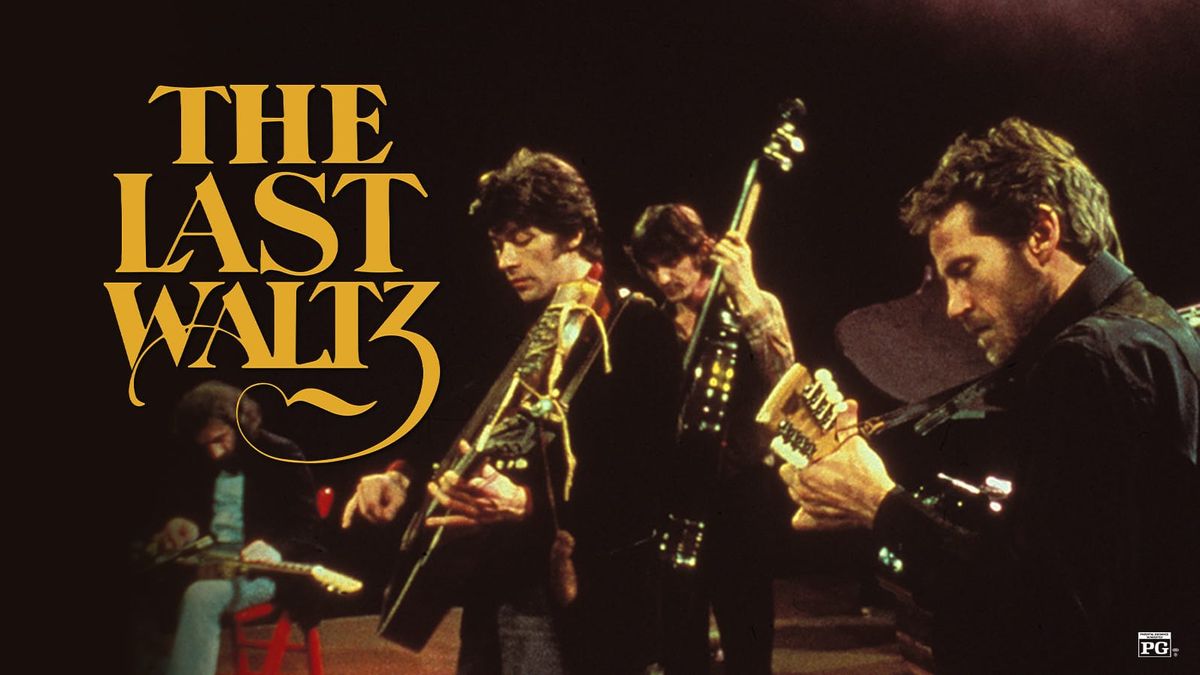
Whether tofurkey or turducken rules the table, there are certain Thanksgiving traditions that will always be timeless — football, a massive Snoopy balloon floating its way down 34th Street, and Van Morrison doing some kicks that could rival a Rockette’s while singing “Caravan” in The Last Waltz.
For half a century, the legendary concert film — directed by Martin Scorsese and filmed on Thanksgiving Day 1976 at San Francisco’s Winterland Ballroom to commemorate The Band’s star-studded farewell show — has been a Turkey Day staple. It remains one of the most beloved music documentaries of all time, and 50 years after Robbie Robertson, Levon Helm, Rick Danko, Richard Manuel, and Garth Hudson left it all on the stage, The Last Waltz continues to be celebrated around this time every year with special screenings and tribute concerts across North America.
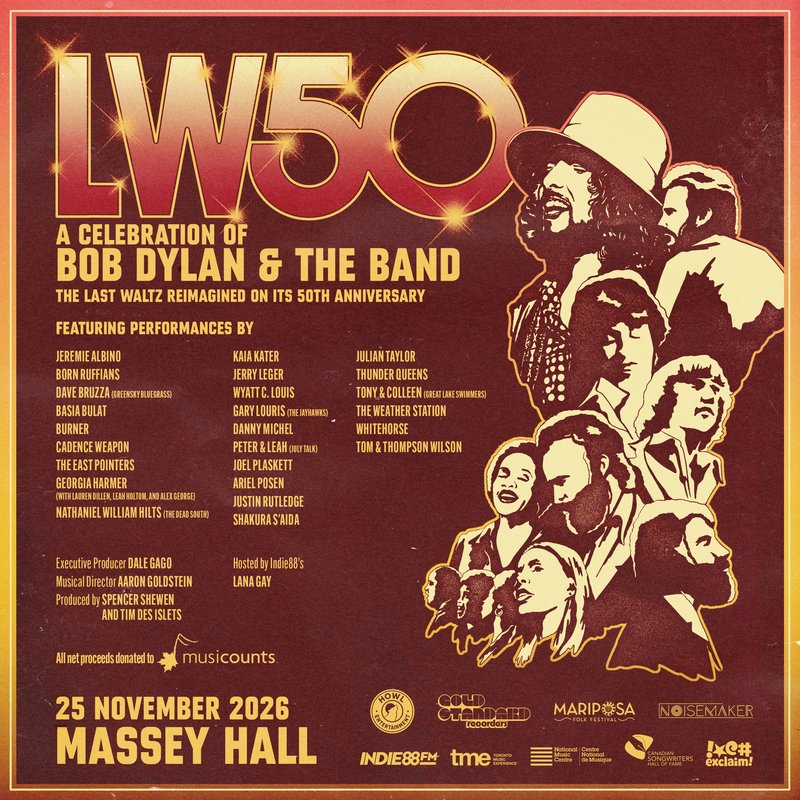
One such concert, “LW50: A Celebration of Bob Dylan and The Band,” will take place tomorrow on November 25 — 50 years to the day from the original concert — at Toronto’s iconic Massey Hall. An impressive lineup of Canadian artists including Basia Bulat, Born Ruffians, Whitehorse, The East Pointers, Great Lake Swimmers, and more will try their hands at the classic tracks, and all proceeds from the show will benefit MusiCounts, Canada’s music education charity. It’s a great cause, of course, but for many artists on the LW50 bill, it’s also a chance to acknowledge the huge impact The Last Waltz had on their own careers.
“As soon as we got the ask, it was an immediate yes,” Tim Chaisson of The East Pointers says. “I’m pretty sure every folk musician is influenced by The Last Waltz in one way or another. It would’ve been a dream to be a part of it. This tribute will be the next best thing.”
“I think it's a testament to really great songwriting and performing, all done with so much heart and soul,” he adds. “It's almost a bible for any musician, or even just a music fan. It gives you a glimpse of what music, friendship, community — and a friggen’ good time, I'm sure — are all about.”
Born Ruffians frontman Luke Lalonde, who will be performing “King Harvest” with his band at LW50, can trace a direct line from the song to one of his earliest tracks, “Hedonistic Me.” “I'd say it's pretty inspired by the world The Band inhabits lyrically — this frontier, pioneer, settler, 19th-century image of an early settler family trying to survive, the hardships and simplicity, the world Robbie Robertson liked to live in lyrically,” he says. “I think I was writing some version of that with ‘Hedonistic Me,’ about living on a farm and this simple, beautiful life. There's a horse named Jethro in one of the verses of ‘King Harvest’ who went mad, and I put the horse Jethro in ‘Hedonistic Me’ as a little nod to The Band.”
The sheer talent on display in The Last Waltz is obviously one of its biggest draws, and there’s something for everyone on the setlist. Tellingly, when the seven people interviewed for this story were asked what their favorite performance from the film is, they each named a different one. As Bulat notes, “It almost feels foolish to try to pick a standout. Even though it's broken down into these moments, and there are so many memorable moments, it's funny: You feel almost silly saying you can't pick one, but you feel just as silly trying to pick one.”
‘Outside of Time’
The Last Waltz is a rarity of a concert film, in that has endured for five decades. As Lalonde points out, it’s a film that somehow manages to feel both timeless and extremely representative of its era.
“There are a couple of ways I think The Band itself endures,” he posits. “They were always sort of outside of time. They came in and, for lack of a better genre term, almost pioneered roots rock, against what was happening in the late '60s with psychedelia and that whole movement. They were wearing these old-timey clothes, playing this simple kind of rock and singing about Civil War characters. They were against the grain in that way, and that sets them outside of time. It's enduring music that ages really well because it was always outside of trends. But The Last Waltz is almost the other side of that coin, this totally emblematic image of mid-'70s rock at its height. All your all-star favorites from the mid-'60s to the mid-'70s are there — from The Staple Singers to Joni Mitchell, Van Morrison, Bob Dylan, everybody. You get this snapshot of the time, and all the lore around it, like Neil Young's coke booger and everything about it. There's a sort of mythmaking around it that has built over time, too. There's something about the mid-'70s that will always be appealing on a purely aesthetic level — the fashion, the way people look, the feel of that movie.”
Great Lake Swimmers’ Tony Dekker agrees: “I think it’s such a well-documented time capsule of music from that era,” he says. “It sounds and looks amazing. But really, I think it’s the songs themselves that have given it a reach through time. So much great music all in one place, played and sung by its creators at crucial points in their careers. And The Band went out on top with their performance, for sure.”
There’s definitely something to be said for knowing when to walk away; the scene where Robertson reflects on The Band’s 16 years of touring and tells Scorsese, “I couldn’t live with 20 years on the road. I don’t think I could even discuss it” almost sounds quaint when so many of his peers have continued gigging well into their 80s.
“They say a person’s biggest party is their funeral, which is pretty brutal when you think of it,” says Canadian radio station Indie88 host Lana Gay, who will serve as LW50’s emcee. “The Band took charge of their farewell and made it a historic snapshot and cultural moment. It also highlights the challenges of being an artist, which hasn’t changed.”
Lalonde also appreciates the way that The Band was able to go out on their own terms and the way that The Last Waltz also represents a changing of the guard. “It's an amazing story — from almost a bar band to a backing band, years doing that with Ronnie Hawkins and then Dylan, and then suddenly emerging as this amazing, era-defining band,” he says. “To have this as their last chapter is incredible. There's something bittersweet and sad about it, too, as their farewell show. It's so emblematic of that era. For everything it represents, and all the people it brings together on one stage, it'll continue to represent '60s and '70s music at a kind of peak, before the '80s came in and changed everything up a bit. Maybe it's not the end chapter in rock and roll, but in a way it's right before disco, Michael Jackson and pop changed things in the late '70s. Maybe that's part of its legacy, too.”
Human Connections
Of course, there’s plenty more that has changed since 1976 — and not for the better. As Whitehorse’s Luke Doucet and Melissa McLelland point out, AI poses a very real threat to so many creative fields, and people are especially starved for content with an obvious human touch. That makes seemingly small connections in The Last Waltz — like when Dylan and The Band navigate a somewhat clunky transition from “Forever Young” to “Baby, Let Me Follow You Down” just by communicating with their eyes, or when a grinning Mavis Staples whispers “Beautiful!” at the end of “The Weight” — more appealing than ever.
“These were artists making art at a time when things were still organic by definition,” Doucet explains. “There wasn't an alternative to that organic [approach]. It hadn't emerged yet. Everything was still just: You're pulling on metal, you're hitting leather, you're hitting plastic, and that's what makes sound. You're controlling the amount of electricity that goes through tubes. It was almost industrial-revolution art, American folk art. Not only were they doing something that was, by definition, incredibly organic, but they were the biggest artists on Earth. If you tried to assemble the biggest artists on Earth today and put them onstage with some old Fender guitars and see what happens, it would be a train wreck, because that's not what music is [for those artists].
“As music and pop culture become more controlled and more plastic, with AI — and even long before that, with Auto-Tune, pitch correction and computer editing everything so that it's supposedly perfect, which really just means horrifying — there's going to be an ever-increasing appetite among a certain sector of listeners and creators who insist on keeping things organic.”
Dekker agrees: “I think it’s the ultimate example of human beings playing in a room together, responding to each other musically, but also being in front of an audience that is clearly a big part of that equation. The fact that they had such a high caliber of friends and guests appearing in a family-picnic style setting only drives that point home. The concert feels spontaneous and unhinged in the best possible way, even at a distance of the half-century of music that came after it.”
But it’s not just the tiny imperfections that make live music, or at least the kind of live music captured in The Last Waltz, feel so human. (As Gay puts it, “Talent outweighed the gloss and glam, technology didn’t steal the show, it was a celebration not just of The Band, but everyone who was part of their community along the way.”) “The thing that really stands out to me is the sense of community and how important that is in music and pop culture,” McLelland says. “I think we're getting so far away from that these days with technology and AI. Although I think a lot of creative stuff can be gleaned through that, we have to maintain that sense of coming together in a really authentic, heartfelt way.”
She continues, “Sometimes I find the best way to make music is to remove all sense of production and just try to tap into that very moment. …Obviously, The Last Waltz was a production. There were cameras and a live audience and all of that. But it definitely transcended beyond that in a way that most music documentaries do not. There was something magical that happened, and it completely blew past whatever was set up for that. There was this magic being made, and I think everybody who watches it feels that and is part of that.”
That strong sense of community is also what initially struck Basia Bulat the first time she watched The Last Waltz. The joy that comes when a bunch of friends get together and collaborate is palpable. “As a musician, and as someone who grew up playing music, this is the kind of feeling I was always chasing,” she says. “It's why I loved playing in orchestras, why I love these big groups and why I love collaborating. That same spirit comes through on the celluloid. It's beautifully captured.
“And it's an era, especially looking back now, when everyone was just crushing it live,” she points out. “There's something about that artistry, that dedication and devotion to instrumentation, to playing together as a band and celebrating a band. I also think there's that camaraderie you feel coming off the film. We're all kind of missing that. You can hear it in the recording and feel it on the screen. It's what we love about live shows in general, what attracts us to music. The fact that we're celebrating it, that we do these tributes to it, it's not merely romanticization. It's the fact that people playing together, friendship, and devotion to your art and to your friends: there's something about that that's evergreen and everlasting.”
Ultimately, it’s not just the fact that it was filmed on Thanksgiving Day that makes The Last Waltz so fitting for this time of year. (And truthfully, with four out of five members of The Band being Canadian, there’s a good chance they actually celebrated the holiday on the second Monday in October with the rest of their countryfolk.) At its core, it’s a remarkable display of gratitude — for the fans, for an unparalleled 16-year career and, most importantly, for the mentors and friends with whom they were so lucky to have the opportunity to play music. It’s about gathering with the people you love, doing what you love and feeling thankful that you were ever able to do so.
“When people think about the way that communal spirit exists within certain pockets of music — and I think it's really strong in Canada — inevitably that points back to The Last Waltz, because that's the high-water mark, the gold standard, the North Star of what it looks like,” Doucet says. “Everybody's like, ‘Hey, let's just do this together and see what happens.’ That's a pretty strong legacy that I think will probably only become more celebrated as time goes on.”

Comments ()