
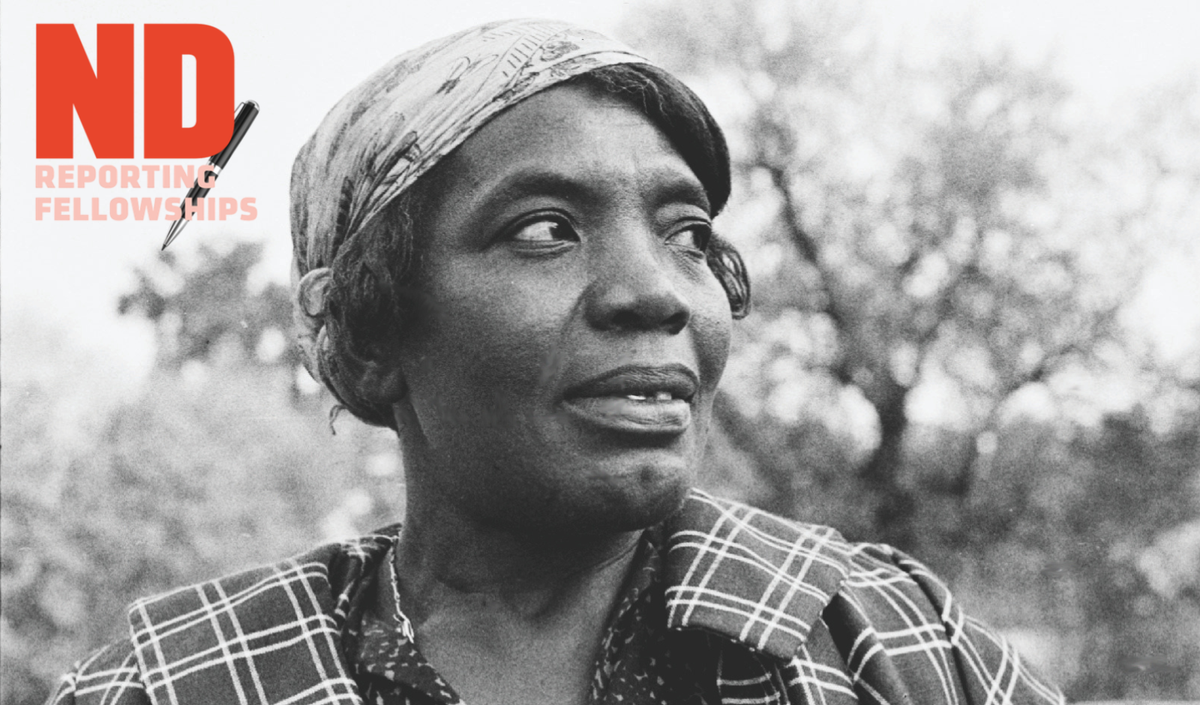
Editor's Note: Santi Elijah Holley has been awarded one of two No Depression Reporting Fellowships to write four in-depth features on a topic deeply impacting roots music today. The Reporting Fellowships kick off with this historical piece introducing spirituals as a foundational form of American roots music and will continue on with three subsequent pieces. Stay tuned for more from both No Depression Reporting Fellows throughout the rest of the year and into 2027.
On the night of Thursday, August 4, 1966, a large crowd of people gathered inside the New Friendship Missionary Baptist Church on the South Side of Chicago for a rally sponsored by the Chicago Freedom Movement. Launched the year before by the Southern Christian Leadership Conference (SCLC) and the Coordinating Council of Community Organizations (CCCO), the Chicago Freedom Movement hoped to carry the momentum of the civil rights movement — which had been thus far concentrated in the South — up north into Chicago, addressing issues particularly plaguing Black Americans in northern cities, such as segregated and substandard housing, and income and employment disparities. Using similar nonviolent tactics employed in southern campaigns, including rallies, marches, and boycotts, the Chicago Freedom Movement has been called “the most ambitious civil rights campaign in the Northern United States.”
The multiracial, though predominately Black, crowd inside New Friendship had come to hear speeches by Jesse Jackson and educator and activist Albert Raby, but they’d come especially to hear from the most prominent voice of the civil rights movement, Martin Luther King, Jr. Over the previous days, the marchers had been confronted by local, racist, White mobs, who attacked them with cherry bombs, bottles, and bricks, leading to over two dozen injuries. That night, King was tasked with reassuring his supporters to carry on their important work, despite the escalating acts of violence against them. The stakes couldn’t have been any higher.
King approached the pulpit, nearly obscured by a jumble of microphones and stands, and looked down at his notes. He seemed to hesitate for a moment, as though apprehensive about his ability to reassure the large, battered crowd before him. Just then, a voice rang out from the side of the stage: “Ohhh Joshua fit the battle of Jericho! Jericho! Jericho!”
All at once, the people inside the church rose to their feet and began clapping their hands and singing along: “Joshua fit the battle of Jericho, and the walls came tumblin’ down!”
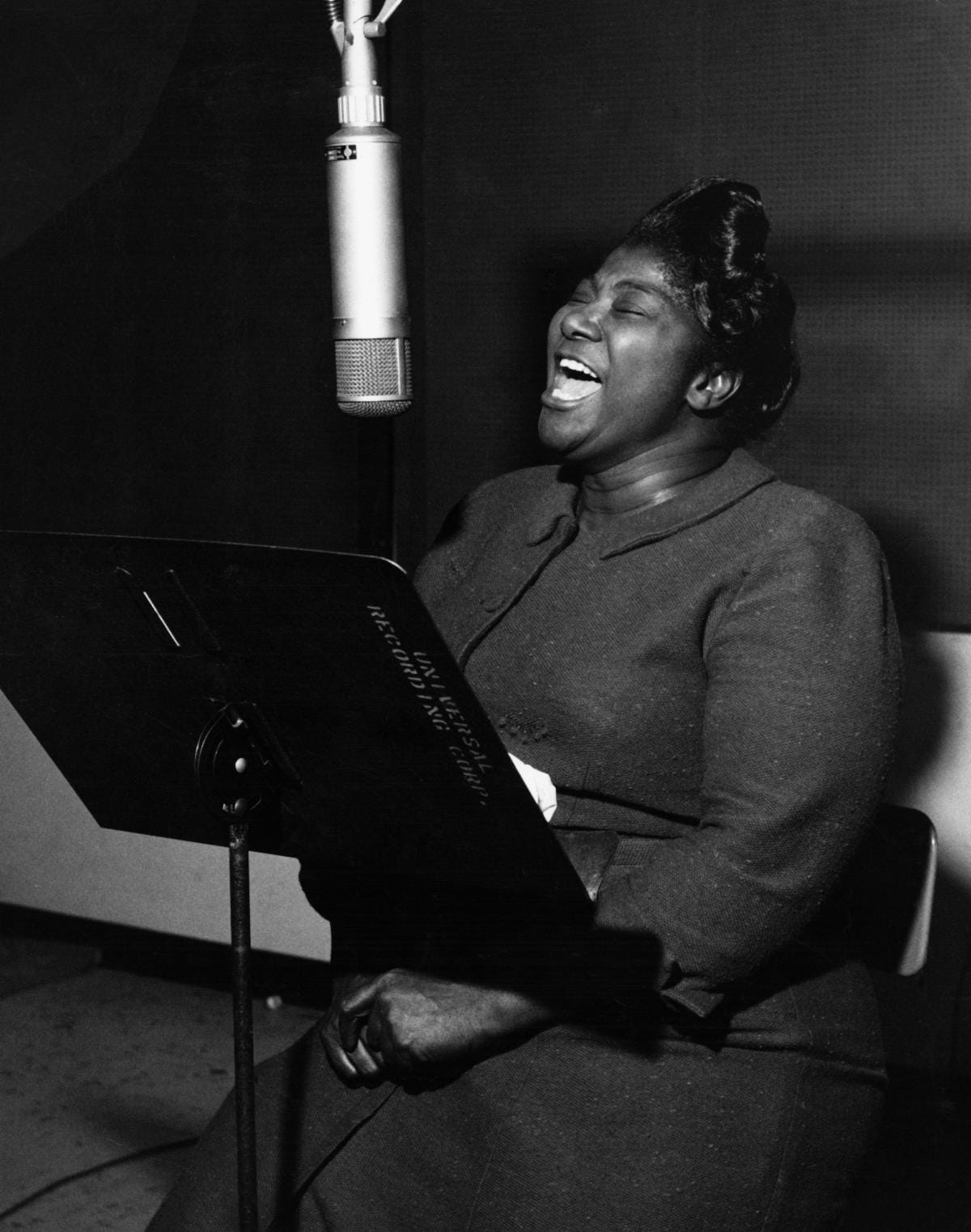
A small, subtle smile appeared on King’s face, and he gave a quick nod, glancing over to his left, where gospel singer Mahalia Jackson led the nearly 2,000 civil rights activists and supporters in the classic African American spiritual.
When the song ended, King appeared revitalized, recharged. He recognized that he had been assigned the role of the biblical Joshua, and Chicago (and wherever else racial segregation exists) was a brutal Jericho, whose walls will collapse only through the power of their shouts.
King then looked with confidence out at the audience. “I think I can say,” he began, “concerning this great gospel singer in our midst — our dear friend, my great friend Mahalia Jackson — that a voice like this comes only once in a millennium.”
Jackson’s seemingly spur-of-the moment decision to come to King’s aid by striking up the old familiar spiritual, was not the first time she’d used her powerful voice in the service of the freedom struggle. Hailed as the “Queen of Gospel,” Jackson had sung at numerous civil rights demonstrations and fundraisers for already a decade, beginning with the 1956 Montgomery bus boycott. For Jackson and many other Black Americans, gospel music wasn’t simply an entertaining musical performance, in praise of some abstract and distant God up in heaven, but a commentary on things happening in present that directly affected themselves and their neighbors. Joshua not only fought at Jericho; he continued to lead the fight in Birmingham, Selma, Memphis, Atlanta, Newark, Detroit, and Chicago. God didn’t only come to Daniel’s aid when he was thrown into the lions’ den; he would come to the aid of Black people suffering from racist discrimination and abuse.
Gospel music was a living soundtrack to the Civil Rights Movement, giving strength and encouragement to marchers as they faced White mob violence; to college students as they were dragged out of diners and lunch counters; and to men, women, and children brutalized by police batons, firehoses, and snarling dogs.
Jackson wasn’t the first singer to connect gospel music to the fight for civil rights and racial equality. She and the other gospel music stars of the day, including Clara Ward and The Staple Singers, were carrying on a centuries-long tradition of reinterpreting and reimagining biblical-era stories to speak out against modern injustices. From the moment that the first enslaved Africans were brought in chains to North America, Black men and women composed and sang religious songs about freedom, justice, and dissent. Black religious songs are America’s original songs of rebellion, accompanying meetings, rallies, marches, sit-ins, union organizing, and worker strikes — and they continue to inspire and inform protest music today.
The Invisible Institution
Before there was anything called gospel music or spirituals, there were slave songs, or what W.E.B. Du Bois called “sorrow songs.” In his seminal 1903 book, The Souls of Black Folk, Du Bois wrote how, “the Negro folk song — the rhythmic cry of the slave — stands to-day not simply as the sole American music, but as the most beautiful expression of human experience born this side of the seas.”
Although the songs now referred to as spirituals were born on the coasts and plantations of North America, Black religious music first flourished in West Africa, well before the transatlantic slave trade and eventual embrace of Christianity by enslaved Africans. “Religious music” in West Africa was, in fact, something of a misnomer, as West Africans did not recognize a duality between the sacred and the secular, or between the spirit and the body. All music was a form of worship.
Distinct from European conventions, which separated religion from daily life, by reserving specific times and accommodations for organized worship, West African life and culture were inseparable from the presence of the gods. As scholar Teresa L. Reed wrote in her 2003 book, The Holy Profane, “Africans get their spiritual revelation and inspiration from neither a book nor their oral tradition but from their lives.” Music is not simply something to observe, contemplate, or consume, but it is a participatory event, involving the whole community. As Reed explained, drumming, singing, and dancing were all employed to communicate with the spirit realm and to generate “a type of energy or life force which the Yoruba call àshe, and encourage the orisha, or lesser divinities, to literally enter and take control of the celebrant’s physical being.”
These spirit possession rituals would also be practiced in the vodou ceremony, which was brought from West Africa to Haiti, Brazil, and the American state of Louisiana (incorporating some elements of Roman Catholicism) during the slave trade between the 16th and 19th centuries. Such spirit possession rituals would years later rematerialize in Pentecostalism — an American-born and historically Black religious movement, grounded in direct, fervent experiences of God through the Holy Spirit. Music was integral to these rituals, as it not only helped the worshipers communicate directly with the Divine, but helped to strengthen bonds with their community, reminding them of their responsibilities, duties, and commitments to each other.
When African captives first arrived in North America in 1619, they spoke Mandinka, Wolof, Ibo, or Yoruba, and the enslavers kept them separated by language, to prevent conspiracies and rebellions. Slaves were caught in a double bind; they weren’t taught English, yet they were prohibited — often under the threat of injury or death — from speaking in their native tongues. Over time, the captives developed unique vernaculars, blending African languages with regional American dialects, and they would likewise create distinctive customs in music, folklore, and religion.
Slaveholders had been initially opposed to teaching Christianity to slaves, believing African Americans lacked the intelligence to understand its creeds and doctrines, or else worried that they might begin to read too literally into the Bible’s prohibitions against slavery. “Slaveholders feared that Christianity would make their slaves not only proud but ungovernable, and even rebellious,” scholar Albert J. Raboteau wrote in his 1978 book Slave Religion. There was also the concern — less openly acknowledged — that by Christianizing African Americans, it would be more difficult to justify enslaving, disenfranchising, or otherwise dehumanizing them. These sentiments were shared by Whites in both the Southern plantations and the northern colonies. As author Robert Darden wrote in his 2004 book People Get Ready!, White Americans feared that “once African Americans learned to speak English, began to dress like ‘proper’ colonials, and were saved by the same God, it made it that much harder to blindly consider them subhuman and lay the lash across their backs.”
By the mid-18th century, African Americans had begun to embrace Christianity — but the Christianity they practiced differed in many respects from the Christianity practiced by White Christians in Europe and America. Incorporating elements of West African faith rituals, the Christianity of enslaved African Americans was participatory, intimate, and ecstatic. Darden wrote how “this revolutionary new religion was not the result of African Americans becoming West European-styled Christians, it was the result of slaves refashioning the Christian religion to make it applicable to their own peculiar institution — slavery.” Christianity assured the slave of his humanity, his dignity, and his worthiness to God. It helped African Americans survive as a people, during the most heinous and barbarous episodes in the history of the Western world. Black American scholar, pastor, and civil rights activist Wyatt Tee Walker wrote in his 1979 book Somebody’s Calling My Name how Christianity, or what he calls “Jesus-faith,” “served to insulate the antebellum slave from the real temptation of collective suicide.”
Because slaveholders forbid Africans from practicing anything that resembled traditional African spirituality, as well as prohibiting large gatherings of slaves, Black men and women in the South — both enslaved and free — would meet and worship clandestinely, either in wooden, one-room shacks called “praise houses,” or in the woods, in places called “brush arbors” (or hush arbors), to worship and pray. This secret, nighttime practice came to be called the “invisible institution.”
Many, if not most, slaves were illiterate, due to racist anti-literacy laws. As such, their knowledge of the Christian bible came orally, typically transmitted by an itinerant preacher who served as evangelist, storyteller, and firebrand. Their Christianity was a syncretization of African traditional religions and American Protestantism, marked by singing, moaning, and an ecstatic ritual called the “ring shout,” in which participants move together in a counterclockwise circle, stomping their feet, clapping their hands, and engaging in call-and-response with the leader. But this was more than a country square dance. The ring shout would go on for extended periods of time, building in force and momentum, until the dancers would become ostensibly possessed by the spirit (or spirits), causing them to whoop and quake and cry out. The ring shout was their way of preserving their African identity and fortifying their community, while also providing a release from the daily horrors of slavery. The ring shout prefigured all Black American music of the 19th and 20th centuries, from spirituals and gospel, to blues, jazz, R&B, and hip-hop. As historian and musicologist Samuel A. Floyd Jr. suggests in his 2002 academic study, “Ring Shout!,” “all of the defining elements of black music are present in the ring.”
Upon learning of the existence of these brush arbor and praise house meetings, plantation owners and lawmakers stipulated that a White person must be present at all times, for fear that the Black congregants were plotting rebellions and uprisings with their strange chants and songs. This paranoia was not entirely unfounded. Many Black people in America — enslaved and free, alike — were believed to have developed secret musical codes to signal and impart urgent information to each other. One of the first examples came as early as 1739, during an incident called the “Stono Rebellion.”
On September 9, 1739, near the Stono River in the colony of South Carolina, an enslaved man called Jemmy, from the Kingdom of Kongo in Central Africa, led an armed militia of 20 or 30 Kongolese slaves, hoping to reach Spanish-controlled Florida. In competition with the British over territory, the Spanish colonialists had promised freedom and land, in an area north of St. Augustine, to any enslaved African who converted to Catholicism and was willing to defend the territory against British colonialists. Because the Kingdom of Kongo was a Catholic country, Jemmy and his fellow Kongolese mutineers were likely already Catholic, literate in Portuguese, and were drawn to Spanish Florida not only by the promise of freedom, but also by their shared faith. As the group made their way to Florida, the rebels burned plantations and massacred more than 20 White men, women, and children, while steadily adding to their ranks with additional runaway slaves. In an account of the rebellion, published in the London Daily Post, and General Advertiser, British colonialist James Oglethorpe described how the rebels’ numbers “increased every minute by new Negroes coming to them, so that they were above Sixty, some say a Hundred, Singing and beating Drums, to draw more Negroes to them.” The drums were a rallying tool, calling other slaves to break away from their plantations and join the insurgents. As author John Jeremiah Sullivan wrote in his 2019 essay, “Talking Drums,” for Oxford American magazine:
They were not drumming randomly or playing in the belief that the mere noise of the drums would bring more slaves running. They were broadcasting code. Familiarity with the technique of what more than a century later came to be called ‘telegraphic drumming’ was (and is) common in multiple regions of Africa. Drummers belonging to various cultures there have long been able to send fairly complex messages over vast distances by employing different percussive rhythms.
A South Carolina colonialist militia confronted the mutineers near Edisto River only one day after the uprising began. In the resulting confrontation, the militia killed nearly 50 of the rebels. The few who escaped that day were soon captured and executed. Altogether, more than 50 African rebels and more than 20 Whites and had been killed during the uprising, making it the largest slave uprising during the colonial era.
In the aftermath of the Stono Rebellion, Governor William Bull and the Province of South Carolina passed the Negro Act of 1740, severely restricting the rights and movement of enslaved Africans, while also permitting slaveholders to whip or, if necessary, kill insubordinate slaves. In addition, the act prohibited enslaved Africans from the “using or keeping of drums, horns, or other loud instruments, which may call together or give sign or notice to one another of their wicked designs and purposes.”
The ban on musical instruments, however, did not keep enslaved Africans from their ability to communicate or broadcast code. With the confiscation of their drums, they turned to a new system of transmitting crucial information to each other — a system that the slaveholder could never take away. Using only the gift of their voices, enslaved Africans would help guide each other to liberation, while also developing the most beautiful and inspirational music yet born in the New World.
The Great Awakening
On July 29, 1794, a freed Black minister named Richard Allen opened the doors to the newly established Bethel African Methodist Episcopal (AME) Church, later known as “Mother Bethel,” housed in a converted blacksmith’s shop on 6th and Lombard Streets in Philadelphia. Born into slavery in 1760, Allen joined the Methodists as a teenager, taught himself to read and write, and in 1780 had earned enough money to purchase his freedom. Six years later, Allen was installed as a preacher at Philadelphia’s St. George’s United Methodist Church, but he and fellow Black Methodist preacher Absalom Jones, opposed to the church’s segregated services, broke off from the church and co-founded the Free African Society, a non-denominational mutual aid organization, which soon led to the establishment of Mother Bethel, the first AME Church in the nation.
Allen published a hymnal for his congregation in 1801, titled A Collection of Hymns and Spiritual Songs: Selected from Various Authors. Despite its prosaic title, the pocketsize, 54-song hymnal proved immensely popular, with a second edition published later that year with 10 additional hymns. These hymns were neither political nor subversive, but intended rather to glorify the Christian God, with lyrics largely reprinted from hymnals written by English ministers Isaac Watts and John and Charles Wesley, the founders of the Methodist movement in America. Allen’s book, however, did differ in one notable way from existing hymnals; it contained the first known printed examples of “wandering refrains,” allowing for improvisation, repetition, and vocalizing — what would later be known in the Black Church as “testifying.”
As Robert Darden wrote in in his 2005 book People Get Ready!: A New History of Black Gospel Music, “These refrain lines and choruses, besides being easy to remember, were structured in such a way that members who felt so moved could shout or moan ‘Yes, Lord’ or ‘Oh, Jesus’ in the ‘empty’ spaces in the music and singing.”
Allen’s hymns were welcomed by no less a dignitary as Charles Wesley, who acknowledged Allen’s originality. In his 1935 biography of Richard Allen, Wesley writes that, by not dutifully imitating White hymns, Allen was “unique in his independence”. But this new, improvisational singing style found its share of criticism, including from Philadelphian chronicler John Fanning Watson, who bemoaned in a 1819 tract of hymns being “composed and sung by the illiterate blacks of the society.”
“In the blacks’ quarter, the coloured people get together,” Watson continued, “and sing for hours together, short scraps of disjointed affirmations, pledges, or prayers, lengthened out with long repetitive choruses. These are all sung in the merry chorus-manner of the southern harvest field, or husking-frolic method, of the slave blacks.”
Because the Black residents of Philadelphia and other northern cities included freed or escaped slaves, or the children of former slaves, Allen’s hymns felt innately familiar to them, reminding them of the communal and more expressive religious songs of the South, where field hollers, work songs, and Du Bois’s “sorrow songs” continued to be sung in brush arbors, plantations, and praise houses, by a people yearning to be free.
“Through the song, black people are able to affirm that Spirit who was continuous with their existence as free beings,” writes Black liberation theologian James H. Cone in his 1972 book, The Spirituals and the Blues, “and they created a new style of religious worship. They shouted and they prayed; they preached and they sang, because they had found something. They encountered a new reality; a new God not enshrined in white churches and religious gatherings.”
Since the arrival of the scattered and often sporadic series of American revivals, from roughly 1730 to 1750—a period that would come to be called the “Great Awakening” — both White and Black Americans, from the colonies to the South, had begun to embrace Christianity in even greater numbers. Initiated by charismatic Anglican evangelist George Whitefield, the First Great Awakening (a Second Great Awakening began in 1790) prioritized an intimate and personal relationship with God, salvation through piety, and emotional outpourings of the Holy Spirit. A highly significant series of events that would go on to shape the future of religion in America, the Great Awakening had a particular impact on Black Americans, as they were now welcomed to fully participate in Christian worship, often joining integrated revivals and churches. For the first time since being brought in chains to the New World, Black men and women were taught that they, just the same as Whites, were the beloved children of God, created equally in God’s likeness. “The revivalism of the Great Awakening, spread over time and space by evangelical preachers, created the conditions for large-scale conversion of the slaves,” wrote Albert J. Raboteau in Slave Religion:
By revitalizing the religious piety of the South, the Awakening(s) stirred an interest in conversion which was turned toward the slaves. By heavily emphasizing the inward conversion experience, the Awakening tended to de-emphasize the outward status of men, and to cause black and white alike to feel personally that Christ had died for them as individuals. Evangelical religion had a universalistic dimension which encouraged preaching to all men, embracing rich and poor, free and slave.
Armed with this radical belief, Black people in America could now see themselves as valued and deserving of respect; they were emboldened to assert their humanity and worthiness, and to advocate for their deliverance — not only in the world to come, but also in the world in which they lived and toiled. And these convictions came to be reflected in the songs they now sung.
While abolitionists in the mid-19th century, especially in the North, composed antislavery hymns and poems, printed in newspapers, journals, hymnals, and songbooks, these efforts were almost exclusively written by White men, to be sung by fellow White abolitionists. These included the seminal 1840 anthology, Freedom’s lyre: or, Psalms, hymns, and sacred songs, for the slave and his friends, compiled by Presbyterian minister Edwin Francis Hatfield; and the 1853 hymnal, Miriam’s Timbrel: Sacred songs suited to revival occasions, and also for antislavery, peace, temperance, and reform meetings, published and distributed by the Wesleyan Methodists. These hymnals and songbooks were intended for White Protestant abolitionists dedicated to social reform and good Christian integrity; they did not include the voices or experiences of enslaved people, nor did they deign to speak directly to the more than three million people still enslaved in the southern states.
But slaves were, in fact, composing and singing their own songs — hundreds of them, to themselves and for their own benefit. These songs were based on Old Testament stories, the life and death of Jesus, and the promise of a heavenly reward in the hereafter. They provided emotional relief, spiritual uplift and, in the years leading up the Civil War, hidden meanings. They were elegiac and deceptively guileless, imbued with ambiguity, for example in the song, “Were You There When They Crucified My Lord?”
Were you there when they nailed Him to the tree?
Were you there when they nailed Him to the tree?
Sometimes it causes me to tremble, tremble, tremble
Were you there when they nailed Him to the tree?
For the slaves singing and listening to this song, the image of being “nailed to the tree” was an intimate and dangerous reality. When the slave likened the horrors of lynching to Christ’s crucifixion, he was seeing himself as similarly persecuted and murdered by the governing authorities. When he asked, “Were you there?” he was asking the listener if he had chosen to remain silent and thereby complicit in the face of injustice.
The song “Steal Away” also includes clever wordplay, in which the singer suggests, to a White listener, that he longs to be spiritually with Jesus in heaven, but other slaves would hear this and understand that the singer is soon plotting an escape from the plantation:
Green trees are bending, poor sinners stand a-trembling
The trumpet sounds within my soul
I haven’t got long to stay here
Steal away, steal away, steal away to Jesus
Steal away, steal away home
I haven’t got long to stay here
“The only place where we could say we did not like slavery, say it for ourselves to hear, was in these old songs,” said Bessie Jones of the Georgia Sea Island Singers, to a group of young civil rights demonstrators in 1964. “We could not read and the master thought he could trap us with no existence and we could do nothing about it. But we did — even as children — with the music. And it is our own; it came from ourselves.”
Frederick Douglass wrote in his 1845 memoir how the “songs of the slave represent the sorrows of his heart; and he is relieved by them, only as an aching heart is relieved by its tears.” These were songs of courage and kinship, in anticipation of a day when all slaves would be free. They insisted that, despite bondage, subjugation, family separation, torture, and lynchings, righteousness would one day prevail.
Booker T. Washington wrote, in an introduction to composer Samuel Coleridge-Taylor’s 1905 songbook, that these songs “breathe a child-like faith in a personal Father, and glow with the hope that the children of bondage will ultimately pass out of the wilderness of slavery into the land of freedom. In singing of a deliverance which they believed would surely come, with bodies swaying, with the enthusiasm born of common experience and of a common hope, they lost sight for the moment of the auction block, of the separation of mother and child, of sister and brother.”
But the singers of these songs were no passive martyrs; they were no suffering servants waiting patiently for the sweet release of death. They plotted and pursued their freedom while they still had breath in their lungs and rhythm in their hearts. The “land of freedom” was the North, far away from the slaveholding South. Their “deliverance” was possible in this lifetime.
Enslaved Blacks in America had already developed a practice of singing songs to help their work go a little easier, to lull their children to sleep, or to retain ancestral stories and traditions. Because slaveholders discouraged any activities, no matter how seemingly innocuous, that might be considered incendiary, slaves learned to use coded language in their songs to express their sorrow and longing. And they would soon use these codes and symbols for yet another purpose — guiding them on their flight to freedom.
Let My People Go
Historians today are divided on how many of these slave songs — what later came to be called “Negro Spirituals” — did in fact use coded language, or hidden messages in the lyrics that gave slaves instructions on how to escape the plantation and find their way to the free states in the North. By the mid-20th century, scholars were already engaged in something akin to biblical typology — the Christian practice of reading the Hebrew Bible for signs and premonitions of the advent of Jesus — while reading each and every song for hidden codes and directives.
One of the earliest proponents of this theory was the Black American historian Miles Mark Fisher, who asserted in his 1953 book, Negro Slave Songs of the United States, that the songs sung by enslaved people alluded not to Jesus and heaven, but emancipation and liberty. Fisher’s examples can sometimes be hyperbolic, with the author engaging in a bit of fantastic presumptuousness. He endorsed a remarkably oversimplistic view of the transatlantic slave trade and the horrors of the Middle Passage: “Negroes loved Africa. Sometimes captives on slave ships jumped overboard and tried to swim back home,” Fisher wrote, as though captive Africans were simply homesick, and not desperate men and women who made the heart-rending choice to drown themselves in the sea rather than suffer in the land to which they were bound.
Fisher maintained that the slave song given the name “The Old Ship of Zion” addresses the slave’s literal desire to board a sailboat and return to Africa, while “The Good Old Way,” also known as “Down to the River to Pray,” represents the slave’s plea for “some Civil War missionary to give help which the African cult did not supply.” Fisher went on to write how, after the Civil War and during the Reconstruction years, such songs as “Jacob’s Ladder” and “Michael Row the Boat Ashore” spoke to the former slave’s wish to leave America for the newly established West African colony of Liberia.
This lyrical exegesis wasn’t unique to Fisher. Distinguished Black American folklorist and ethnomusicologist John Lovell, Jr., in his 1939 essay, “The Social Implications of the Negro Spiritual,” wrote how the Biblical themes and images present in the spirituals were not “dainty little fantasies of song,” but the defiant and revolutionary poetry of the downtrodden:
Satan is not a traditional Negro goblin; he is the people who beat and cheat the slave. King Jesus is not just the abstract Christ; he is whoever helps the oppressed and disenfranchised, or gives him a right to his life. Babylon and Winter are slavery as it stands—note “Oh de winter, de winter, de winter’ll soon be ober children.”
Some songs, such as “Going to Shout All Over God’s Heaven” (also known as “All God’s Children Got Shoes,” among other names), may have been an example of a veiled “protest song.” When the singer sang, “I got shoes, you got shoes, all of God’s children got shoes,” he may have been challenging the notion that God would give preferential treatment to anyone depending on race. And when he sang, “Everybody talkin’ about heaven ain’t going there,” he may have been pointing these remarks at the Whites who professed themselves to be Christian while owning other human beings. In his 1945 book Deep River, renowned Black theologian and civil rights pioneer, Howard Thurman described “Going to Shout All Over God’s Heaven” as, “one of the authentic songs of protest. It was sung in anticipation of a time that even yet has not fully come — a time when there shall be no slave row in the church, no gallery set aside for the slave, no special place, no segregation, no badge of facial and social stigma, but compete freedom of movement.”
No mortal figure factored in the slave songs higher than the great abolitionist and liberator Harriet Tubman. In his 1943 biography of Harriet Tubman, author Earl Conrad wrote how “one could go through every major experience of Harriet Tubman and find that she expressed her victories in songs; songs that are now known to us as spirituals. Music was a means, a leverage, a shrewd resort; it was a mask for the real Negro who was, beneath the melody, thinking, planning and advancing.”
Other authors and historians would further support the theory that the spiritual “Go Down, Moses” was Tubman’s theme song — her “fighting song,” in the words of Conrad — like a leitmotif played when the hero appears onscreen. Drawing from the Book of Exodus, when God commands Moses to return to Egypt and demand Pharaoh release the Israelites from 400 years of slavery, “Go Down, Moses,” with its call-and-response arrangement (and its countless variations, interpretations, modifications, and up to as many as 24 stanzas), unambiguously linked the legend of the Israelites in Egypt to the plight of Africans in America:
When Israel was in Egypt-land
Let My people go!
Oppressed so hard they could not stand
Let My people go!
Go down, Moses
Way down in Egypt-land
Tell old Pharaoh
Let My people go!
No more shall they in bondage toil
Let My people go!
Let them come out with Egypt’s spoil
Let My people go!
The Lord told Moses what to do
Let my people go!
To lead the Hebrew children through
Let My people go!
As Israel stood by the waterside
Let My people go!
At God’s command it did divide
Let My people go!
When they had reached the other shore
Let My people go!
They let the song of triumph soar
Let My people go!
You need not always weep and mourn
Let My people go!
And wear these slav’ry chains forlorn
Let My people go!
Lord, help us all from bondage flee
Let My people go!
And let us all in Christ be free
Let My people go!
Your foes shall not before you stand
Let My people go!
And you’ll possess fair Canaan’s land
Let My people go!
The Israelites were strangers in a strange land, where all they had known was servitude and subjugation. The opening chapter of Exodus relates how Pharaoh, nervous about how fruitful the Israelites had become in Egypt, “put slave masters over them to oppress them with forced labor, and they built Pithom and Rameses as store cities for Pharaoh. But the more they were oppressed, the more they multiplied and spread; so the Egyptians came to dread the Israelites and worked them ruthlessly. They made their lives bitter with harsh labor in brick and mortar and with all kinds of work in the fields; in all their harsh labor the Egyptians worked them ruthlessly.”
When enslaved Africans in America learned the stories of the bible — usually transmitted orally by either an itinerant Black preacher or, in some cases, a local White clergyman — they identified at once with the Israelites, driven by the lash of the taskmaster’s whip to gather straw with which to build bricks. In Exodus, Moses kills an Egyptian who had been brutalizing a Hebrew slave, then flees Egypt for the land of Midian. An angel of God one day appears to Moses in a burning bush and orders him back to Egypt. “And now the cry of the Israelites has reached me, and I have seen the way the Egyptians are oppressing them,” God tells Moses. “So now, go. I am sending you to Pharaoh to bring my people the Israelites out of Egypt.”
The slave songs celebrated Moses as a liberator and redeemer, who’d risked his own safety to free his people from bondage. When they sang “Tell old Pharaoh / To let My people go!” they were not singing about some faraway events that had happened thousands of years ago; it was happening here and now. Egypt was the American South. Pharaoh was the enslaver on the plantation. “My people” was all of God’s people — especially those who had been exploited and persecuted by the powerful. And Moses, too, was a flesh-and-blood person who, like the Hebrew prophet, risked her own freedom to redeem her kinsfolk.
Harriet Tubman — who’d escaped from slavery in September 1849 with the assistance of the secret network of abolitionist safe houses known as the Underground Railroad — made the perilous journey back South to Maryland, to guide other enslaved people to freedom in the North. Tubman would ultimately return to Maryland 13 times over 10 years, leading approximately 70 people — primarily friends and family — to freedom. White newspaper publisher, diehard abolitionist, and friend and supporter of Tubman, William Lloyd Garrison, gave her the nickname “Moses,” which soon caught on among the slaves on Southern plantations.
In her 1868 biography of Tubman, Scenes in the Life of Harriet Tubman (later reprinted as Harriet, the Moses of Her People) author Sarah Hopkins Bradford wrote how Tubman would sing “Go Down, Moses” from a hidden position in the woods, to alert slaves of her approach and to prepare to flee. Bradford writes that Tubman would also sing another hymn, “Hail, Oh Hail, Ye Happy Spirits,” to announce her arrival:
Hail, oh hail, ye happy spirits
Death no more shall make you fear
Grief nor sorrow, pain nor anguish
Shall no more distress you here
Around Him are ten thousand angels
Always ready to obey command
They are always hovering ‘round you
‘Til you reach de heavenly land
Bradford’s biography has since been shown to contain exaggerations and other inaccuracies, particularly in the number of slaves Tubman led to freedom, but the contention that Tubman sang hymns as gathering songs was upheld by others who knew her, including women’s suffrage advocate Alice Stone Blackwell, who was quoted in Conrad’s book as saying that, “Harriet Tubman told me that when she was conveying parties of fugitives, she used to guide them by the songs that she sang as she walked along the roads…it was when her parties were in hiding, that she directed them by her songs, as to whether they might show themselves, or must continue to lie low.”
“Go Down, Moses” and “Hail, Oh Hail, Ye Happy Spirits” were not the only songs sung to assist slaves on their escape to the North. “Wade in the Water” — a poignant song about river baptism — was supposedly sung to remind fleeing slaves how to throw off the scent of the pursuing bloodhounds, while “Follow the Drinking Gourd” is said to have taught slaves to look up to the Big Dipper asterism (resembling a drinking ladle or gourd), which pointed to the North Star and acted as a navigational device, guiding them north toward freedom. The words to “Follow the Drinking Gourd” were reportedly taught to slaves by a mysterious old sailor (or carpenter) and abolitionist going by the name Peg Leg Joe, who inserted unambiguously detailed instructions for slaves to locate the trail of the Underground Railroad:
Follow the drinking gourd
Follow the drinking gourd
For the old man is a-waiting for to carry you to freedom
If you follow the drinking gourd
When the sun comes back and the first quail calls
Follow the drinking gourd
For the old man is a-waiting for to carry you to freedom
If you follow the drinking gourd
The riverbank makes a very good road
The dead trees will show you the way
Left foot, peg foot, traveling on
Follow the drinking gourd
The river ends between two hills
Follow the drinking gourd
There’s another river on the other side
Follow the drinking gourd
When the great big river meets the little river
Follow the drinking gourd
For the old man is a-waiting for to carry you to freedom
If you follow the drinking gourd
While the “old man” ostensibly refers to Peg Leg Joe, the line “left foot, peg foot,” was rumored to have directed the slave to follow the marks left in the dirt and on trees by his wooden right leg. This story has been and continues to be repeated as fact since at least 1910, when it was first spread by folklorist and song collector H.B. Parks. While no character named “Peg Leg Joe” is named in the actual song itself, Parks claimed Peg Leg Joe’s remarkable feats were disclosed to him by a former slave. This theory has been disputed in recent years, however, most notably by academic James B. Kelly, who noted in his 2008 study, “Song, Story, or History: Resisting Claims of a Coded Message in the African American Spiritual ‘Follow the Drinking Gourd,’” that no other mention of this song exists prior to Parks’s mention of it. Kelly also questioned the existence of the enigmatic Peg Leg Joe, pointing out that his name bears a striking similarity to the West African Iwa (spirit or deity) called Papa Legba, who is a central figure in vodou traditions. Kelly noted that Papa Legba is “often depicted in the New World as an old man with a cane or crutch, who serves as ‘the gatekeeper’ and dispenses wisdom that might help a traveler find the way through confusing terrain.”
“Peg Leg Joe,” then, could have either been a misheard or misunderstood name — a “mondegreen” — by White listeners, or an example of slaves incorporating remnants of their former tradition into their new environment, reimagining Papa Legba as Peg Leg Joe.
Despite the mystery of Peg Leg Joe and his remarkable prosthetic leg, the meaning of “Follow the Drinking Gourd” is, without a doubt, puzzling. But the popular theory that it was a coded escape song largely rests on the belief that uneducated slaves would immediately comprehend astronavigation.
The song “Steal Away,” mentioned above, has also been widely believed to be a call for slaves to steal away from the plantation and head north. Like how “Go Down, Moses” was purportedly sung by Harriet Tubman, “Steal Away” is also believed by some scholars and historians to have been personally sung by slave insurrectionist Nat Turner, during his bloody crusade through Southampton County, Virginia in 1831. In his 1955 book, The Story of American Folk Song, Russell Ames wrote how Turner “called his fellow conspirators to secret meetings” by singing “Steal Away.” Ames suggests that when slaves sung the lines, “You can’t keep the world from moverin’ around / And not turn her back from the gaining ground,” they were in fact singing, “And Nat Turner back from the gaining ground.” Ames continued that, following Turner’s rebellion, slaves were prohibited from singing many of their songs, and by the arrival of the Civil War, Black people were put in jail in Georgetown, South Carolina, for singing the song “My Father, How Long?” also known as “We Shall Be Free.”
My father how long
My father how long
My father how long
Poor sinner suffer here
And it won’t be long
And it won’t be long
And it won’t be long
Poor sinner suffer here
We’ll soon be free
We’ll soon be free
We’ll soon be free
The Lord will call us home
Many more songs are considered by scholars and music historians to be associated directly with the Underground Railroad, including “Swing Low, Swing Chariot,” “Down in the River to Pray,” and “Michael Row the Boat Ashore.” These are the songs that allegedly contained hidden codes to help slaves escape to the North.
Other songs, not necessarily imbued with escape instructions, are still believed to have held double meanings, which expressed the singer’s yearning for freedom from bondage. In “Good News, Member,” the “good news” is not, in Ames’s opinion, the good news of the Christian gospel, but a “singing telegraph” informing the listener of a friend or family member who had escaped and reached freedom. In “Didn’t My Lord Deliver Daniel?” the singer testifies that the same God who “delivered Daniel from the lion’s den / And Jonah from the belly of the whale / And the Hebrew children from the fiery furnace” has the power to deliver everyone who continues to suffer from injustice and subjugation. Because of its insistence that everyone — Black and White alike — is deserving of deliverance, John Lovell, Jr., in his 1972 book, Black Song, lauded “Didn’t My Lord Deliver Daniel?” as “the best song of freedom,” while author Richard Newman, in his 1998 book, Go Down, Moses, considered it “perhaps the most politically radical of all the spirituals.”
Furthermore, when the slaves sang of longing to reach “Canaan Land” or “Canaan’s Land,” they were evidently referring to Canada, or any free state in the North. Frederick Douglass wrote in his 1855 autobiography, My Bondage and My Freedom: “A keen observer might have detected in our repeated singing of ‘O Canaan, sweet Canaan, I am bound for the land of Canaan,” something more than a hope of reaching heaven. We meant to reach the north — and the north was our Canaan.”
As James B. Kelly pointed out, however, Douglass’s oft-cited quote doesn’t lend support to the theory that these songs were “singing telegraphs,” or that they contained hidden codes for insurrection. “If anything can be said to be encoded in these song lyrics,” he wrote, “viewed in the context of Douglass’ surrounding comments, it is a general desire to escape to the North or, at best, Douglass’ own, barely contained excitement about his upcoming escape attempt, but it is certainly not a specific set of instructions or even a signal to act.”
While it is credible that many (though not all) slaves sung and interpreted these songs with a profound yearning for earthly freedom, the insistence on assigning an even deeper meaning behind the lyrics — code words, hidden instructions, secret meetings, calls for a slave uprising — became popular only in the years after the Civil War and the end of slavery. Obviously, Black men and women wouldn’t freely divulge this information while still under the yoke of slavery, but there are few records of newly freed people confirming this allegedly widespread conspiracy. Rather, this theory seems to be introduced after the turn of the century, by sympathetic White Northerners and educated free Blacks, who may have been embarrassed by what they’d perceived as the naïve religiosity of the slaves. It was inconceivable that enslaved Africans would cry out to “the White man’s God,” as the Christian God was referred to in elite circles; they’d had to be communicating covertly with Harriet Tubman or Nat Turner. It was unacceptable that slaves would look forward to a day when they could walk in heaven, “where the streets are paved with gold;” they must instead be alluding to walking the snowy streets of Ontario.
The appeal in ascribing complex and often contradictory meanings to these songs became more popular as organized religion itself became less popular. This historical revisionism not only relies on a generous amount of linguistic acrobatics, but it doesn’t take slaves at their word. When they sang, “If you get to heaven before I do, tell my Jesus I’m a-comin’ too,” they were not being cagey or devious; they were stating unequivocally that they would soon be free from the sorrows of the world and meet their savior face to face. And that was enough to carry them through one more day.
From Slave Songs to Spirituals
The prevalent theory that slave songs contained coded instructions for escape is impossible to prove or disprove, but it is certain that many songs did address — either directly or indirectly — the slave’s despair with bondage and his desire for freedom, either in this world or in the world to come. These songs took inspiration from the well-known stories of the Hebrew and Christian bibles, which they interpreted and reframed to suit their peculiar position. Whether they believed literally in the miracles and wonders of the bible was immaterial to the morals and lessons gained by these stories. Robert Darden wrote in People Get Ready! how the “greatest lyrical gift” of these songs lay in the “‘unknown composers’ extraordinary ability to transform the heroes (and villains) of the bible into a shared experience that not only taught theology but created a universal literature, an ethical model, and a method of disseminating information as well as providing a precious few moments of respite and entertainment and a source of succor to the afflicted and abused.”
Little attention or study was given to slave songs (“spiritual” hadn’t yet become widely used) until the arrival of the Civil War. One of the first White Americans to appreciate the significance of these songs was Colonel Thomas Wentworth Higginson, a Union solider, Unitarian minister, supporter of Harriet Tubman and John Brown, women’s suffrage advocate, and strident abolitionist. Higginson led the Union Army’s 1st South Carolina Colored Infantry Regiment — the first officially recognized Black regiment to fight in the Civil War, composed of freed Black people and escaped slaves. Listening to his soldiers singing their songs during marches and sitting around the campfire, Higginson took copious notes on dozens of the songs he’d heard. In June 1867, in an article for The Atlantic Monthly titled “Negro Spirituals,” Higginson wrote how “history cannot afford to lose this portion of its record.”
Higginson gave names to the shouts and songs he’d heard, including such spirituals as “Hold Your Light (On Canaan’s Shore),” “Ship of Zion,” and “Lord, Remember Me” as well as such secular songs as “Hangman Johnny,” “Rain Fall and Wet Becky Lawton,” and “Many Thousand Go,” also known as “No More Auction Block.” An example of what would later be called a “protest song,” “Many Thousand Go” (or “Many Thousand Gone”) is the singer’s plaintive and unequivocal longing for the day when he would be freed from chattel slavery. Unlike many other slave songs, its meaning is not at all coded or cryptic. Its message is crystal clear:
No more auction block for me
No more, no more
No more auction block for me
Many thousand gone
No more peck of corn for me
No more, no more
No more peck of corn for me
Many thousand gone
No more driver’s lash for me
No more, no more
No more drivers’ lash for me
Many thousand gone
No more pint of salt for me
No more, no more
No more pint of salt for me
Many thousand gone
As Confederate fortresses and ports along the Atlantic seaboard began to fall to the Union army, scores of slaves began fleeing across Union lines into the safety and protection of Union camps. Major General Benjamin Butler, while in command at Fort Monroe, Virginia, maintained that escaped slaves were “captured enemy property,” and he termed them “contraband of war,” which caught on and led to more than 100 “contraband camps,” sheltering tens of thousands of escaped slaves, many of whom were put to work as laborers for the Union effort or voluntarily enlisting in the Union army as the United States Colored Troops (USCT). Inside these contraband camps, Black men, women, and children existed in an indeterminate state — no longer slaves, but not entirely free — and they passed the time by singing the same songs they’d learned on the plantations. But now Northern abolitionists and social reformers began to recognize the value of collecting and disseminating these songs more widely.
In September 1861, Reverend Lewis C. Lockwood was appointed by the American Missionary Association, to transcribe a song that he’d heard sung at the contraband camp at Fort Monroe. Lockwood transcribed the song’s 20 stanzas, which were printed by the New York Tribune on December 2, 1861, followed on December 14 by the National Anti-Slavery Standard, who published both the words and music. It was given the title “O Let My People Go” and dubbed “The Song of the Contrabands,” but the former slaves knew the song by its more familiar name, “Go Down, Moses.”
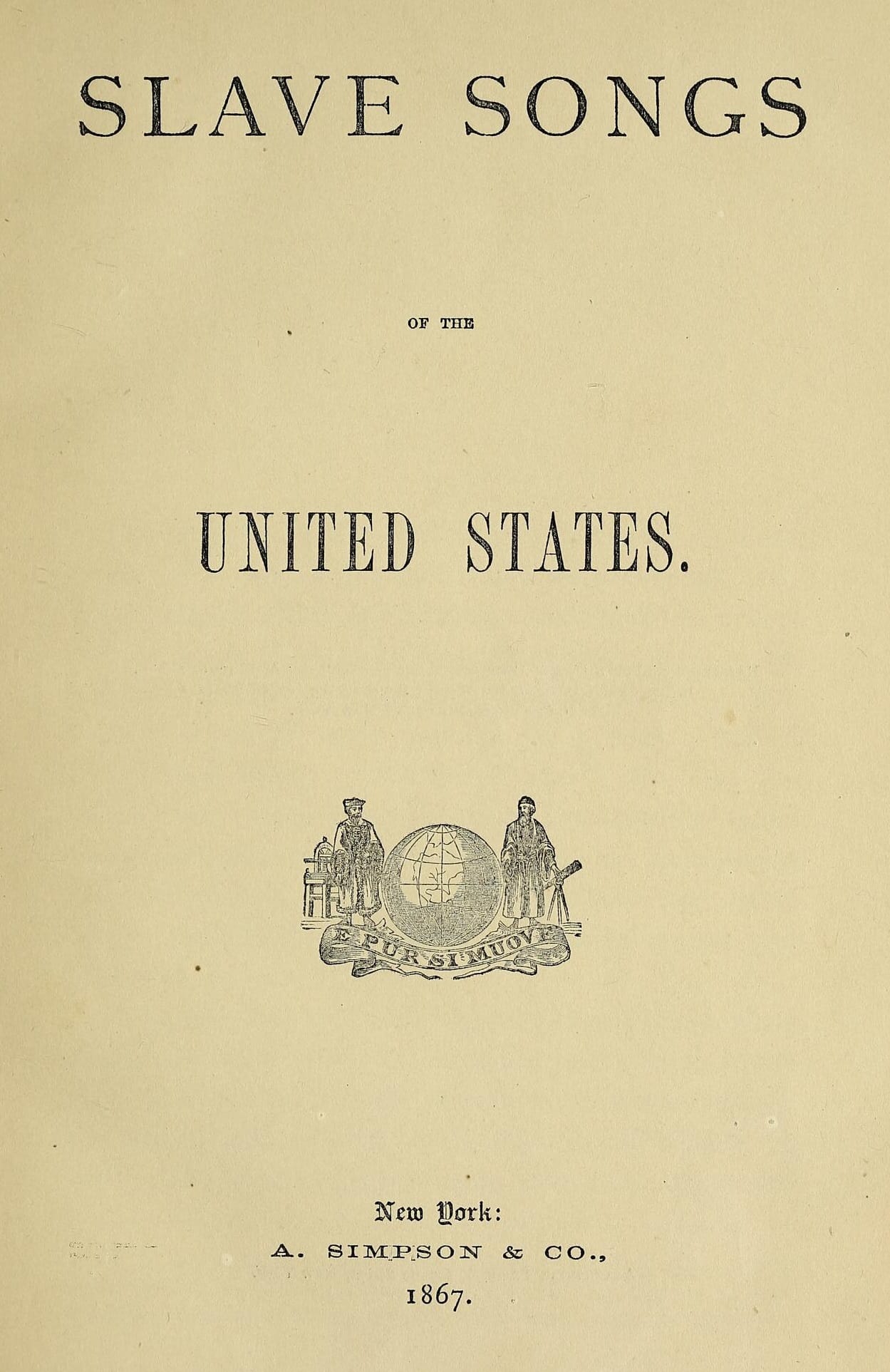
The interest in the music of enslaved Blacks continued to grow as the Civil War dragged on, with White, Northern song collectors and scholars seeking out and documenting these songs, which could be used as propaganda for abolitionist efforts. In 1862, Philadelphia abolitionist James Miller McKim and his daughter Lucy McKim (later Lucy McKim Garrison) traveled to Union-controlled Port Royal, South Carolina, to assist with educating recently freed slaves. While there, Lucy toured the Sea Islands and became enamored by the songs she’d heard the people singing. She documented them, wrote about them, and advocated for their preservation. When she returned home to New Jersey, Lucy supplemented her song collection with those of two other song collectors and abolitionists, Charles P. Ware and William F. Allen. In 1867, they published their shared collection in a book, with the title Slave Songs of the United States.
Cataloguing the songs by the regions where they were collected — from the southeastern and inland slave states to the northern seaboard slave states and Gulf states — the authors added annotations, notations, and “directions for singing.” The authors were mindful not to denigrate, patronize, or parody the songs or the singers; they approached these songs as genuine and original folk music to be studied and treated with respect. They acknowledged the limitations of transcribing the lyricism of the songs to the page. The authors followed the guideline set forth earlier by Higginson in his own collection: “The words will be given, as nearly as possible, in the original dialect; and if the spelling seems sometimes inconsistent, or the misspelling insufficient, it is because I could get no nearer.”
Of course, the songs documented by Higginson, Garrison, Ware, and Allen had probably never before been sung the way they’d been transcribed by these collectors, and they were probably never sung the same way again. These songs were largely mutable and improvisational, changing with each performance, depending on the singer and how he was feeling in that moment. The idea of writing down and recording music was foreign to people of African descent. Furthermore, the singers — many of them having only recently escaped from a life of enslavement — had to consider that they were performing for White folks. Regardless how apparently well-intentioned they were, the singer would’ve been cautious not to divulge any potentially incriminating information.
Slave Songs of the United States comprised 136 songs, and while a few secular, bawdy, or “Jim Crow” songs were included, the overwhelming majority were “spirituals,” as they were now beginning to be more universally called. The songs in the anthology showed the virtuosity, prolificacy, and imagination of Black people in America, presenting spirituals as a fundamental American musical form. It confirmed that Black people in America, even those born and raised in slavery, were capable of great and lasting art.
But already these collectors and supporters were concerned that spirituals were at risk of being lost, corrupted, or otherwise whitewashed. In his introduction to Slave Songs of the United States, Allen admitted the difficulty in finding authentic examples of Negro spirituals, untainted by White influence, and quoted a “Mrs. H.B. Stowe” (almost certainly the renowned abolitionist and author of Uncle Tom’s Cabin, Harriet Beecher Stowe), who bemoaned that “the ‘spirituals’ are going out of use on the plantations, superseded by the new style of religious music, ‘closely imitated from the white people, which is solemn, dull and nasal, consisting in repeating two lines of a hymn and then singing it, and then two more, ad infinitum…This style of proceeding they evidently consider the more dignified style of the two, as being a closer imitation of white, genteel worship — having in it about as little soul as most stereotyped religious forms of well instructed congregation.’”
Though it didn’t garner very much attention when it was published in 1867, Robert Darden writes that Slave Songs of the United States “is today regarded as a milestone not just in African-American music but in modern folk history.” In his preface to a 1995 reprinting of Slave Songs of the United States, American folklorist and anthropologist Harold Courlander hailed the song collection as “something like our first orbital lunar flight. It was not the end but a beginning that helped set a course from which, thereafter, there would be no turning back.” Slave Songs of the United States could be similarly compared to song collector Harry Smith’s Anthology of American Folk Music, which was received poorly upon its release in 1952 but would go on to forever impact American music.
On January 1, 1863, President Abraham Lincoln issued the Emancipation Proclamation, freeing more than 3.5 million enslaved Black people in the Confederate states. Two years later, on April 9, 1865, Confederate general Robert E. Lee surrendered at the Appomattox Court House in North Virgina, effectively marking the end of the Civil War. News of the Confederate surrender spread gradually from plantation to plantation, through what Booker T. Washington labelled the “grape-vine telegraph.” In his 1901 autobiography, Up from Slavery, Washington recalls when the news of the Union victory reached his own plantation in Piedmont Virginia:
[T]here was more singing in the slave quarters than usual. The singing was bolder, had more ring, and lasted later into the night. Most of the verses of the plantation songs had some reference to freedom. True, they had sung those same verses before, but they had been careful to explain that the ‘freedom’ in these songs referred to the next world, and had no connection with life in this world. Now they gradually threw off the mask, and were not afraid to let it be known the “freedom” in their songs meant freedom of the body in this world.
What W.E.B. Du Bois had termed “sorrow songs” were now cries of triumph and elation. The songs that enslaved people had conceived, developed, and cherished, either as a balm for the agony of bondage or to impart secret codes for escape, had evolved into a magnificent new musical form. The so-called “slave songs” had, by the end of the end of the 19th century, been given a name befitting their splendor and significance: spirituals. Where the spiritual had once offered comfort and hope to the slave, it now provided the newly freed men and women with confirmation that they were, indeed, God’s children. “The spirituals are songs about black souls, ‘stretching out into the outskirts of God’s eternity,’” James H. Cone wrote in The Spirituals and the Blues, “and affirming the Word that makes you know that you are a human being — no matter what white people say.”
As the Hebrew slaves had been delivered by God in the story of Exodus, the African slaves, too, had been delivered by a mighty hand. The music that had been born in grief and despair had fortified Black people as they fled the plantations, lifted their voices together, and proclaimed their right to live free. “Like tears, [spirituals] were relief to aching hearts,” said blues songwriter and composer W.C. Handy. “Personally, I think these spirituals did more for our emancipation than all the guns of the Civil War.”
In the years following the Civil War, spirituals — and its successor called “gospel” — would journey far beyond the slave quarters, plantations, and brush arbors, and reach across the world, performed in prestigious concert halls, in presidential ballrooms, and on the frontlines of American protest movements.
The Fisk Jubilee Singers, Mahalia Jackson, Clara Ward, Sister Rosetta Tharpe, James Cleveland, The Staple Singers, Blind Boys of Alabama, and many more spiritual and gospel singers were the direct heirs of those “unknown composers” — who writer James Weldon Johnson hailed in his 1917 poem as “black and unknown bards.” The music born from enslaved Africans would go on to shape the future of American music, while the descendants of those slaves continued to use the music of the church and the stories of the bible in their ongoing fights for civil liberties, human rights, and deliverance.
Santi Elijah Holley is an award-winning journalist, essayist, and author of three books, including An Amerikan Family: The Shakurs and the Nation They Created, and the forthcoming Beg Borrow Steal: The Visionary Art of Melvin Van Peebles and the Rise of Independent Black Cinema.

Comments ()