
Editor's Note: Santi Elijah Holley has been awarded one of two No Depression Reporting Fellowships to write four in-depth features on a topic deeply impacting roots music today. Read his first chapter, which introduces spirituals as a foundational form of American roots music, here, and stay tuned for more from both No Depression Reporting Fellows throughout the rest of the year and into 2027.
When the Civil War ended in 1865, four million Black men, women, and children who had only known perpetual servitude found themselves miraculously freed. Since being brought in chains to America in 1619, Africans had been considered by enslavers as little less than subhuman, nothing more than property — to be bought, sold, driven, beaten, and massacred at will. The descendants of those first Africans to arrive in Virginia had inherited the loss, shame, and grief of their parents, grandparents, and great-grandparents, wondering to themselves if their miseries would ever end. Black people had existed in America for nearly 250 years under the constant threat of kidnapping and permanent subjugation, with few legal protections. With the ratification of the 13th Amendment on December 6, 1865, involuntary servitude became prohibited by law, followed in 1868 by the 14th Amendment, granting citizenship to Black people born in the United States of America, and equal protection under the law. Black people in this country were no longer strangers in a strange land; they were now US citizens.
From the earliest slave songs to the advent of the spirituals, Africans in America had prayed, shouted, composed and sang songs in hope and anticipation of the day God would deliver them and bring about their emancipation. And at long last, that day had arrived.
“To most of the four million black folk emancipated by civil war, God was real,” wrote scholar W.E.B. Du Bois in his 1935 book, Black Reconstruction. “They knew Him. They had met Him personally in many a wild orgy of religious frenzy, or in the black stillness of the night. His plan for them was clear; they were to suffer and be degraded, and then afterwards by Divine edict, raised to manhood and power; and so on January 1, 1863, He made them free.”
Du Bois was referencing the date when President Abraham Lincoln signed the Emancipation Proclamation, freeing only the slaves held in Confederate states. Indeed, the “four million black folk” were not all freed in one go. During the war, tens of thousands of slaves fled from plantations across Union lines and were granted their freedom, with many of the former slaves living in “contraband camps.” Nearly 250,000 slaves in Galveston, Texas hadn’t learned of their emancipation until June 19, 1865 — a day now celebrated as the Juneteenth national holiday. With the Union victory and the effective end of slavery in America, Black believers would credit their liberation to their unbending trust and faith in God. Like the Israelites they sang about in their songs and spirituals, Black people in America had now, too, been liberated from bondage. God had not forgotten them.
“For the slaves in the South, the end of the Civil War meant that as they had believed and sung all along, God had intervened on their behalf,” wrote scholar Robert Darden in his 2014 book, Nothing but Love in God’s Water. “Through their unwavering faith, their spirituals, and their prayers, they had played an active part in their own deliverance.”
Where such spirituals as “Go Down Moses,” “Follow the Drinking Gourd,” and “Steal Away” were said to have assisted slaves on their escape to freedom, by providing coded instructions and directions, other songs and hymns like “The Old Ship of Zion,” “Didn’t My Lord Deliver Daniel?” and “Swing Low, Sweet Chariot” offered the slave the promise of a brighter day — either in this world or the world to come — when he would be freed forever from captivity. But now the slaves had been lawfully emancipated, with no need for cryptic meanings and messages, and the promise of freedom had been fulfilled. Of what benefit were spirituals to the newly emancipated Black Americans?
By the end of the 19th century, spirituals were already being viewed by many Black Americans as an anachronism — a painful reminder of slavery, which had only recently been dissolved. “First generation” Blacks — the children born of former slaves after Emancipation — regarded spirituals with contempt and ridicule. They couldn’t relate to these enigmatic, mournful songs. They couldn’t understand why their parents and grandparents would stand around and sing about Jesus on Calvary and Moses in Egypt and Daniel in the lions’ den, when they had been facing hell right here on the plantation. While the older folks credited the end of slavery to God and His infinite mercy, the younger folks wondered why God had taken so damn long.
But it wasn’t only Northern congregations that had discarded the spirituals. Southern churches and church leaders, too, were now turning their noses up at such “primitive” music. The prominent clergyman and abolitionist David Alexander Payne — sixth bishop of the African Methodist Episcopal Church (AME) who, upon assuming the presidency of Wilberforce University, became the country’s first Black college president — was an outspoken critic of spirituals and ring shouts, or what he derided as “corn-field ditties.” In his 1888 memoirs, he recalls visiting a “bush meeting” 10 years earlier, upon the invitation of its pastor. Payne was scandalized by what he’d witnessed:
After the sermon they formed a ring, and with coats off sung, clapped their hands and stamped their feet in a most ridiculous and heathenish way. I requested the pastor to go and stop their dancing. At his request they stopped their dancing and clapping of hands, but remained singing and rocking their bodies to and fro. This they did for about fifteen minutes. I then went, and taking their leader by the arm requested him to desist and to sit down and sing in a rational manner. I told him also that it was a heathenish way to worship and disgraceful to themselves, the race, and the Christian name. In that instance they broke up their ring; but would not sit down, and walked sullenly away.
What had been the singing and dancing tradition of enslaved Africans in America, which they had developed and nurtured and protected for centuries — the songs they had risked their own lives to sing — were now seen by many of their descendants as aberrant, embarrassing, and improper. The music that had come to be known as spirituals may have become summarily discarded and extinct before the arrival of the 20th century, if not for an ensemble of college students at Fisk University.
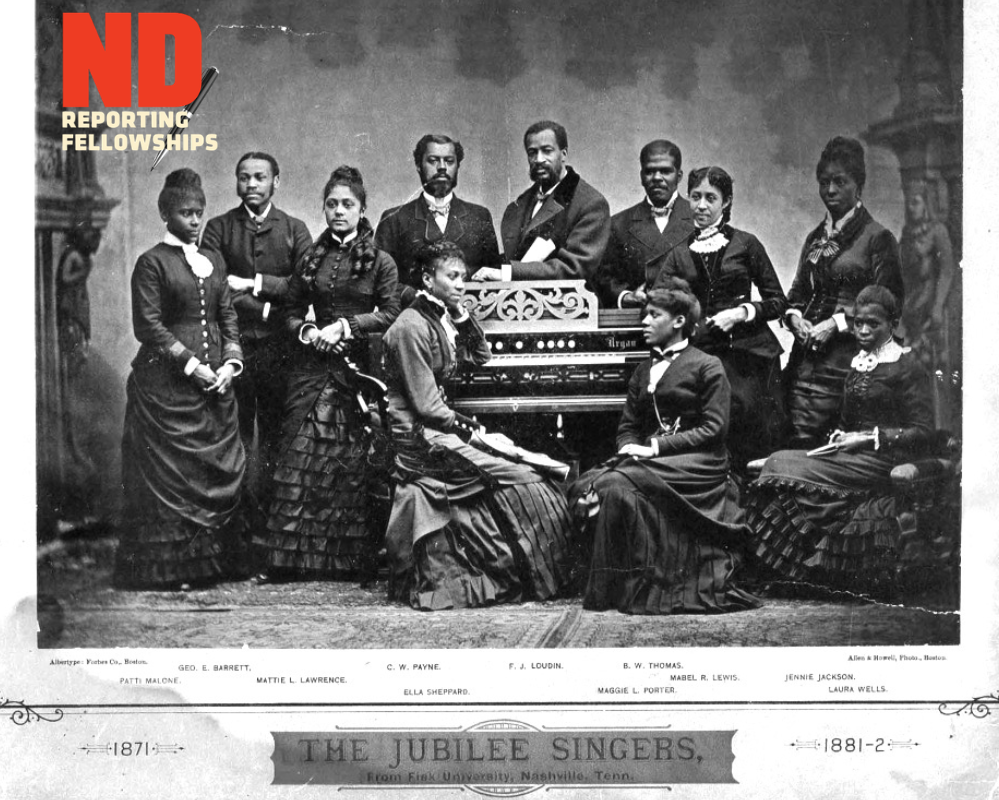
The Fisk Jubilee Singers
Opened in Nashville, Tennessee in 1866, Fisk University was founded by the American Missionary Association, to provide higher education to young or recently freed Black Americans, but it was soon beset by financial difficulties. Within five years, Fisk was under threat of bankruptcy and closure. University treasurer and music teacher, George Leonard White, recognized that some of the students were talented singers and saw an opportunity to help raise desperately needed funds. White enlisted nine students — five women and four men — for a yet-unnamed choir, with the goal of raising $20,000 for the struggling university. Early performances, at college halls and conventions, received mixed reviews and meager donations. On October 6, 1871, the choir left Nashville on a fundraising tour of the United States and, after much praying and debating, White arrived at an official name for the ensemble, The Jubilee Singers. The name was in reference to the biblical “Year of Jubilee,” from Leviticus 25, when all slaves were commanded by God to be set free.
The Jubilee Singers (they wouldn’t be referred to as the Fisk Jubilee Singers until years later) soon found more receptive and giving audiences, especially after a New York performance hosted by prominent abolitionist and minister Henry Ward Beecher, who lauded the singers and encouraged his parishioners to donate abundantly. A performance at Brooklyn’s Lafayette Avenue Presbyterian Church inspired another abolitionist and minister, Theodore Ledyard Cuyler, to extoll the choir, in the pages of the New York Tribune, as “the genuine soul-music of the slave cabins.”
The music first performed by the Jubilee Singers, however, was a far cry from the music of the slave cabins and plantations. Early setlists mainly comprised parlor songs, temperance songs, and other such sentimental ballads as “Home Sweet Home” and “Old Folks at Home” (also known as “Swanee River”). Spirituals were performed only intermittently and often reluctantly by the singers. But when they saw how the spirituals garnered the greatest and most enthusiastic response from the audience, these songs took center stage.
The predominately White, liberal, northern audiences were enraptured by what they viewed as authentic slave songs and spirituals, performed by “genuine Negroes,” as opposed to the blackface minstrelsy that had gained in popularity since the end of the Civil War. By early 1872, the Jubilee Singers’ repertoire included such spirituals as “Swing Low, Sweet Chariot,” “Roll, Jordan, Roll,” “Steal Away to Jesus,” and the fabled “Go Down, Moses.”
As the Jubilee Singers toured the North, Northeast, and Midwest, they continued to attract White fans and benefactors. One of their greatest champions was the writer Mark Twain. In a letter written to his English publisher in March 1873, Twain offers a flattering (though patronizing) recommendation for the singers:
I think these gentlemen & ladies make eloquent music—& what is as much to the point, they reproduce the true melody of the plantations, & are the only persons I ever heard accomplish this on the public platform. The so-called “negro minstrels” simply mis-represent the thing; I do not think they ever saw a plantation or ever heard a slave sing.
I was reared in the South, & my father owned slaves, & I do not know when anything has so moved me as did the plaintive melodies of the Jubilee Singers. It was the first time for twenty-five or thirty years that I had heard such songs, or heard them sung in the genuine old way—& it is a way, I think, that white people cannot imitate—& never can, for that matter, for one must have been a slave himself in order to feel what that life was & so convey the pathos of it in the music.
The Jubilee Singers toured at a grueling pace, quickly becoming one of the most sought-after acts in the nation, and on March 5, 1872, they were invited to the White House to meet President Ulysses S. Grant. “And these are the ‘Jubilee Singers’ I have read so much of,” Grant declared, shaking their hands, according to Andrew Ward in his 2000 book Dark Midnight When I Rise. “I am very much interested and hope you may have a glorious success.” Grant asked them to sing a song. They chose “Go Down, Moses.”
When Israel was in Egypt-land
Let My people go!
Oppressed so hard they could not stand
Let My people go!
Go down, Moses
Way down in Egypt-land
Tell old Pharaoh
Let My people go!
No more shall they in bondage toil
Let My people go!
Let them come out with Egypt’s spoil
Let My people go!
The Lord told Moses what to do
Let my people go!
To lead the Hebrew children through
Let My people go!
The singers undoubtedly recognized the significance of this moment. Here were formerly enslaved people and the children of formerly enslaved people, singing a song about demanding freedom from slavery to the President of the United States, who had played a significant role in securing that freedom. But the choir’s successes and accolades came also with the paternalism, dehumanization, and barely disguised racism of supposedly liberal Whites. Some of their hosts quipped how a couple of the singers, who had once been slaves, were surely of greater monetary value now than when they’d been property. As Ward noted in Dark Midnight When I Rise, one clergyman in Washington, DC, remarked how the Jubilee Singers “are black, some of them jet black, the best of the female voices coming from the thickest of negro lips.” In a review of one performance, The Newark Evening Courier called the singers “picanninies” and commented on their features as though they were at auction; while a critic for the New York World wrote that the singers “had the air of well-trained monkeys when put upon the scientific, but as the programme touched a wild darky air, [they] limbered out instantly and sung with mellowness and life.”
The singers were obliged to remain silent and composed. Despite their national prominence, they knew their freedom was still tenuous and not wholly guaranteed.
In April 1873, The Jubilee Singers made their way across the pond, touring Europe and England, where they performed “Go Down, Moses” and “Steal Away to Jesus” at the Court of Queen Victoria. Again, Ward acknowledged in his book that the singers were met with similar objectifications as in the US: Her Majesty did not address the singers directly but later reflected that they were “real Negroes” who (erroneously) “have all been slaves, some having been sold several times.”
The Jubilee Singers continued their exhaustive tour, with some singers leaving and others taking their place. Initially setting out to raise $20,000 to save their university, by the time they finally returned to Nashville in July 1878, the Jubilee Singers had raised an estimated $150,000 (more than $5 million in today’s dollars), which went toward purchasing new land and funding construction of its first permanent structure, Jubilee Hall. This ensemble of Black college students, comprising former slaves and children of slaves, had grown into one of the biggest musical acts in the world. The Jubilee Singers continued to tour well into the 20th century, with a rotating cast of singers and choir directors, including prominent Black American composer and musicologist John Wesley Work, Jr., who managed the choir for nearly two decades, from 1899 to 1923.
As Ward wrote, the Jubilees “introduced vast white audiences to slave hymns: the first authentic African American music most whites had ever heard.”
But the “authenticity” of the Jubilee Singers’ music was debatable. Spirituals were the product of enslaved Africans in America, who’d first sung these songs to themselves on Southern plantations and in secret bush arbors and praise houses. This was the music that provided them with hope, comfort, courage, and kinship. These were the songs sung to alleviate their pains, to worship their god, and perhaps to impart secret instructions on how to escape the plantation and find freedom. This was the first art created by Black people in America, sustaining them for over two millennia. And these songs were now being sung for liberal White audiences, in prestigious concert halls and seats of government. These songs that were designed to be improvisational, participatory, and rhapsodic, were now notated, commodified, and made comfortable for respectable White society. The spirituals soon came to bear a close resemblance to classical European hymns and anthems.
The success of the Jubilee Singers brought about numerous imitators, with over a dozen singing groups calling themselves the National Jubilee Singers, the Jackson Jubilee Singers, Sheppard’s Colored Jubilee Singers, the Alabama Jubilee Singers, the New Canaan Jubilee Singers, the Wilmington Jubilee Singers, and the Utica Jubilee Singers of Mississippi. The original Jubilee Singers eventually came to be referred to as the “Fisk Jubilee Singers,” to differentiate them in what was becoming an overcrowded field. Once a spontaneous and impassioned response to the horrors of slavery, spirituals has become a profitable marketing label.
In his 1974 book, Blacking Up, author Robert C. Toll wrote how the Fisk Jubilee Singers and their many imitators “‘cleaned up’ the music to conform to whites’ religious ideas and musical criteria in order to create a favorable impression.”
One of the most vocal critics of this music was the Black American writer Zora Neale Hurston. “There never has been a presentation of genuine Negro spirituals to any audience anywhere,” Hurston wrote in her 1934 essay, “Spirituals and Neo-Spirituals.” “What is being sung by the concert artists and glee clubs are the works of Negro composers or adaptors based on the spirituals.”
Hurston acknowledges the pleasing and proficient qualities of this new music — what she calls “neo-spirituals” — but she vigorously contests these performances as being genuine representations of spirituals. “Glee clubs and concert singers put on tuxedos, bow prettily to the audience, get the pitch and burst into magnificent song — but not Negro song,” she continues. “The real Negro singer cares nothing about pitch. The first notes just burst out and rest of the church join in — fired by the same inner urge.”
The spirituals of the early 20th century had undoubtedly evolved (or, to some critics, degenerated) beyond its primitive origins on the slave plantations and brush arbors, but these new singing groups provided a vital role in keeping these songs alive after emancipation. Despite how palatable or “cleaned up” they had since become, the songs sung by these college-educated, classically trained singers were, in their own right, stirring, evocative, and often transcendent. To celebrated father-and-son folklorists John and Alan Lomax, the debate over the perceived authenticity or genuineness of these spirituals was immaterial to their enduring beauty.
“Whatever their origin, whatever their structure, whatever their components — there can be no question in the minds and hearts of those who have heard them that in the Negro spirituals American folk art reaches its highest point,” the authors wrote in their 1947 book, The 111 Best American Ballads. “Indeed, we assert that these songs form the most impressive body of music so far produced by Americans, ranking with the best of music anywhere on this earth.”
Eventually this singing style would be designated as “jubilee,” distinguishing it from antebellum spirituals, though many listeners would use the two names interchangeably. Among the more popular of these jubilee groups were the Pace Jubilee Singers, founded in Chicago in 1925 by Black musician and composer Charles Henry Pace; and the Four Harmony Kings, founded by singer William A. Hann in 1916. Singing both religious and secular songs, the Four Harmony Kings toured throughout the US and Europe, recorded for several labels, and performed in the long-running 1922 Broadway revue Shuffle Along (a young, aspiring singer and actor named Paul Robeson would replace Hann during the revue’s final month). By the early 1930s, jubilee would itself be supplanted by another new singing style — less polished and more spontaneous. Jubilee-quartet groups — later evolving to simply “quartets” — would bring the liveliness, spirit, and vitality back into Black religious music.
Old Time Religion
Beginning in 1910 and continuing for nearly six decades, millions of Black Americans living in the South fled their homes and journeyed to northern and midwestern cities, escaping Jim Crow racism and discrimination, while pursuing economic opportunities. The largest mass movement of people in United States history, the Great Migration would forever alter the landscape of racial demographics and American race relations. As Isabel Wilkerson writes in her 2010 book, The Warmth of Other Suns, the Great Migration would “transform urban America and recast the social and political order of every city it touched.”
While these migrants found industrial work in automobile factories, steel mills, and meatpacking plants, they were often driven into crowded, blighted, and segregated neighborhoods. And with Black migrants now competing for jobs with European migrants and other working-class White Americans, White resentment grew against Black workers, and the southern migrants quickly found themselves up against the same racist abuse they’d hoped to escape. Tensions between White and Black workers often boiled over into violence — most disastrously with the 1917 East St. Louis riots, which resulted in the deaths of at least eight White Americans and at least 39 Black Americans (some figures estimate the number of Black victims to be between 100 and 200), $400,000 in property damage, and the displacement of more than 6,000 Black residents; and the “Red Summer” of 1919, which lasted nearly 10 months and spread to more than three-dozen cities, ultimately resulting in the massacre of hundreds of Black Americans by aggrieved White mobs.
Despite the ever-present threats of violence against them, Black migrants preserved their culture, music, and religion. “The diaspora was largely a migration of Baptists, millions of Baptists,” writes author James N. Gregory in his 2005 book The Southern Diaspora. Though the great majority of migrants were Baptist, other denominations grew precipitously, especially Pentecostal, Holiness, and Apostolic — known collectively as “sanctified” churches. Emerging in the early 20th century, sanctified churchgoers practiced an active and exuberant form of worship, involving singing, clapping hands, and beating tambourines. They shouted and prayed to blessed by the Holy Spirit — or to “catch the Holy Ghost” — which manifested itself by feverish dancing, glossolalia (speaking in tongues), or throwing themselves on the ground, calling to memory African worship traditions and the clandestine ring shouts of the antebellum plantations. The sanctified church released Black Christians from the strictures of White, middle-class Protestantism, and they were now free to reestablish a worship practice that more closely resembled that of their ancestors. In an essay written circa the 1930s, Zora Neale Hurston wrote that the sanctified church was “a revitalizing element in Negro music and religion. It is putting back into Negro religion those elements which were brought over from Africa and grafted onto Christianity as soon as the Negro came in contact with it, but which are being rooted out as the American Negro approaches white concepts.”
Black Christians in Chicago, New York, Detroit, Philadelphia, and other metropolitan northern cities joined or instituted a growing number of Pentecostal and Holiness denominations, including the Church of God in Christ (COGIC), which would grow into the largest Pentecostal denomination in the country and the largest African American Pentecostal denomination in the world. Services were often held in small, storefront churches, where congregants could worship exuberantly, making use of musical instruments that had, until then, been considered “worldly,” like guitars and drums, in addition to pianos and organs. Robert Darden wrote in his 2004 book, People Get Ready!: A New History of Black Gospel Music, how Pentecostal churches believed their use of instruments during praise services had been encouraged by Psalms 150:3-6:
Praise him with the sound of the trumpet: praise him with the psaltery and harp.
Praise him with the timbrel and dance: praise him with stringed instruments and organs.
Praise him upon the loud cymbals: praise him upon the high sounding cymbals.
Let every thing that hath breath praise the Lord. Praise ye the Lord.
“In basements and storefront churches,” Darden wrote, “the exhausted workers from the South found the counterparts of the mystic brush arbor ring shouts and ecstatic musical release from backbreaking labor in a strange land. They found a piece of home.”
But the music they played in these storefront churches sounded markedly different from sorrow songs and spirituals that had once been sung down home. Blues and jazz were gaining in popularity, especially among younger generations, and it was inevitable that these rhythms would permeate the Pentecostal and Holiness church.
In a 1963 newspaper article, the poet Langston Hughes recalled when he was a teenager in Chicago around the time of World War I and happened to come across a Holiness service for the first time. “I was entranced by their stepped-up rhythms, tambourines, hand clapping, and uninhibited dynamics, rivaled only by Ma Rainey singing the blues at the old Monogram Theater…The music of these less formal Negro churches early took hold of me, moved me and thrilled me.”
The incorporation of spirited and syncopated rhythms sparked life into the Black church during yet another time of great upheaval and uncertainty. As Black people were again uprooted from their homes and obliged to rebuild their lives in an unfamiliar land, they again revised both their religion and their music, to reflect their new environment. But the music they made in the city, rather than doleful and desolate, was lively and vivacious, reflecting both their bustling urban environment and their adoption of (or, indeed, their return to) more expressive worship practices. Less elegant or refined than the Fisk Jubilee Singers or the Pace Jubilee Singers, these latest groups took the fundaments of the antebellum spirituals and added modern elements. These groups would come to be called “jubilee quartets,” which described both the style of music and the group itself. (“Quartet” was applied uniformly, regardless of how many members were in a group, though these groups typically comprised four to six singers.)
Among the first to reflect this emerging style was an a cappella quartet called Mitchell’s Christian Singers, founded in the early 1930s by four day laborers in Kinston, North Carolina. Discovered by music talent scout J.B. Long, Mitchell’s Christian Singers — named for singer and band manager Willie Mitchell — cut several records for Columbia, Vocalion, OKeh, and other labels, and were championed by another renowned scout, John Hammond, who booked the group for his celebrated “From Spirituals to Swing” concert at Carnegie Hall on December 23, 1938, along with The Count Basie Orchestra, Big Joe Turner, and a young singer and guitar player named Sister Rosetta Tharpe. “They were so good, so pure, so non-commercial,” Hammond recalled of Mitchell’s Christian Singers in Darden’s book. “There was no hype, no show business tricks, like side-slapping.”
Other similar quartets soon formed and began to cut records, featuring a cappella singing, close harmonies, swinging rhythms, and a tenor singer— the “soloist” — who served as lead vocalist. As the other singers held the rhythm and melody, the soloist was freed to improvise, shout, or testify, as the spirit so moved him. Such groups as the Norfolk Jubilee Quartette, the Silver Leaf Quartette, the Famous Blue Jay Singers, and the Selah Jubilee Singers recorded and performed regularly in the North and South throughout the 1930s. The success of these quartets corresponded to the so-called “golden age of radio,” when millions of Americans were turning to home radio for news and entertainment, and these live radio broadcasts helped to fuel what would become, at one time, one of the most popular musical styles in the country.
With their close vocal harmonies and a cappella singing, jubilee quartets were very similar to barbershop quartets. But where barbershop quartet singing has long been associated with White male singers (dressed in matching, dapper uniforms), historians now locate its origins with Black Americans on street corners and saloons as early as the late 19th century. Jubilee-quartet music and, later, doo-wop, effectively reclaimed quartet singing for Black America.
The Southernaires, the Spirit of Memphis Quartet, the Harmonizing Four, the Heavenly Gospel Singers, and many other quartets were earning regular radio play and popularity with their spirituals-influenced jubilee music, but, following the massive popularity of the family singing quartet, the Mills Brothers, Black Christian quartets would push themselves into even more innovative territories.
Formed in the late 1920s, the Mills Brothers were four African American brothers from Piqua, Ohio, who took the harmonies of the barbershop quartets and added jazz instrumentation and swing rhythms, often using their own voices to mimic brass instruments and washtub bass. This “pump bass” vocal technique would become fundamental to nearly all successive quartet and gospel groups for the next three decades. With a repertoire consisting solely of such secular songs and standards as “Lazy River,” Basin Street Blues,” and the chart-topping “Paper Doll,” the Mills Brothers were popular with both Black and White audiences, going on to sell 50 million records globally and earning more than three dozen gold records.
The Mills Brothers inspired four teenage students at Booker T. Washington High School in Norfolk, Virginia, who would form a quartet in 1935 and call themselves the Golden Gate Jubilee Quartet, later shortened to the Golden Gate Quartet, or, colloquially, “The Gates.” (The “Golden Gate” of their name was likely chosen for its heavenly connotation and not in tribute to the famous San Francisco landmark, though the Golden Gate Bridge had, incidentally, begun construction only two years earlier). Performing a cappella, with the impeccably close harmonies and precision of the Mills Brothers, the Gates sang mostly upbeat, spiritual-influenced jubilee songs like “Found a Wonderful Savior,” “John the Revelator,” and “Joshua Fit the Battle of Jericho,” but they also included the occasional secular song like “Dipsy Doodle” and “Swanee River.” The jazzy, syncopated sound of the Gates wasn’t immediately embraced by the Black churches where they’d given their first performances.
“In some of the churches, their preachers wouldn’t allow us to sing in their church because we were singing this type of music that had a really fantastic rhythm,” recalled founding member Orlandus Wilson. “And with the syncopations that we were doing, they said it was jazz. We was doing too much jazz, and it didn’t go with the religious spirit of the songs. And we weren’t allowed to sing in some churches, and some churches that we — that they did allow us to sing in, we could only sing from the floor of the church. We couldn’t sing from the rostrum, from the pulpit.”
The Gates soon found a more accepting audience after performing at the second “From Spirituals to Swing” concert in 1939, with the Benny Goodman Sextet, featuring jazz guitarist Charlie Christian and vibraphonist Lionel Hampton, followed by a residency at the Greenwich Village nightclub, Café Society, and a recording contract with Columbia subsidiary OKeh Records. In 1941, upon the invitation of First Lady Eleanor Roosevelt, the Gates performed at President Roosevelt’s third inauguration and continued to perform periodically at the White House. Like the Mills Brothers, the Gates would also go on to have massive crossover success, appearing in a number of Hollywood movies and singing such secular songs “Hit the Road to Dreamland,” “The General Jumped at Dawn,” and the World War II patriotic song, “Stalin Wasn’t Stallin’,” written by group member Willie Johnson in 1943, in celebration of Joseph Stalin’s resistance against Adolph Hitler’s invasion of the Soviet Union. With its melody and lyrics inspired by barbershop and jubilee quartets, “Stalin Wasn’t Stallin’” was a novelty song, with jocular lyrics ballyhooing the alliance between the United States, England, and the Soviet Union, in the fight against Nazi Germany:
Well now, Stalin wasn’t stallin’
When he told the beast of Berlin
That they’d never rest contented
‘Til they had driven him from the land
So he called the Yanks and English
And proceeded to extinguish
The Führer and his vermin
This is how it all began
Now, the devil, he was reading
In the Good Book one day
How the Lord created Adam
To walk the righteous way
And it made the devil jealous
He turned green up to his horns
And he swore by things unholy
That’d he’d make one of his own
So he packed two suitcases
Full of grief and misery
And he caught the Midnight Special
Going down in Germany
Then he mixed his lies and hatred
With fire and brimstone
Then the devil sat upon it
That’s how Adolf was born
The same year the Gates wrote and recorded “Stalin Wasn’t Stallin’,” songwriter Ervin Drake wrote a song called “No Restricted Signs in Heaven,” in reaction to racial segregation in the United States. The son of Jewish immigrants, Drake would go on to write the American standards “I Believe” and “It Was a Very Good Year,” which would earn Frank Sinatra a Grammy Award for Best Male Vocal Performance in 1966. But in 1943, Drake was still in his early 20s, trying to catch his first big break, while also trying to affect social change. “I didn’t want it to seem like a message song so I did it with a boogie-woogie tempo,” Drake recalled in a 1996 interview.
He brought “No Restricted Signs (Up in Heaven)” to what was then a new recording label, Capitol Records, which had been founded the year before by Johnny Mercer, Buddy De Sylva, and Glen Wallichs. “Johnny wanted to record it,” Drake said. “He showed it to his partner, and Glen said, ‘John, the way things are in this country if you record that song we will lose our distributorship.’” After Capitol passed on the song, it found its way to the Golden Gate Quartet, who recorded it in 1946 and released it on Columbia Records the following year.
Featuring piano and drums, in addition to the group’s familiar close harmonies, “No Restricted Signs (Up in Heaven)” sounds much like any other pop song of the day. You could snap your fingers or jitterbug to it. But, like the coded slave spirituals of the previous century, its lyrics used biblical imagery to speak out against racial segregation and class discrimination:
Knock-a knock-a knock knock, knock knock
Folks were knocking at the Pearly Gates
Knock knock, knock knock
Askin’ ‘bout the rooms and ‘bout the rates
Knock knock, knock knock
Knock knock knocking at the pearly gates
Knock knock, knock knock
Askin’ ‘bout the rooms and ‘bout the rates
Ol’ Saint Peter was the official greeter
He was present to let them in
Some looked down because their skins were brown
But Pete hollered with a great big grin
“You’re Welcome! Welcome!”
There are no restricted signs in heaven
And there’s no selected clientele
There are no restricted signs in heaven
Brother, brother, that goes double
Hallelujah!
Knock knock, knock knock
Pete, he said, “Now won’t you follow me?”
Knock knock, knock knock
They looked around and what did they see?
Snow white angels, colored angels
Sons of David and Chinese
“You don’t have to look swell, not for this hotel
You can even check in in your dungarees
You’re welcome! Welcome!”
There are no restricted signs in heaven
And there’s no selected clientele
There are no restricted signs in heaven
Brother, brother, that goes double
Hallelujah!
During the first half of the 20th century, Black Americans in the North were presented with more employment opportunities, primarily in such industries as automobile, shipbuilding, steel, and meatpacking. Between 1910 and 1920, the number of Black workers in industrial jobs rose from 500,000 to 901,000. But even with these gains, Black workers were routinely paid less than their White counterparts and faced ongoing workplace discrimination and intimidation. Despite contributing to massive labor shortages during World War I — the result of millions of Americans drafted and shipped overseas, combined with the country’s restriction on European immigration — Black workers were harassed by employers and White coworkers. Many Black workers were routinely prohibited from joining labor unions, including the American Federation of Labor (AFL). African American workers were welcomed, however, by the Congress of Industrial Organizations (CIO), founded in 1935 by labor leader John L. Lewis, as a rival federation that was committed to accepting Blacks, women, recent immigrants, unskilled workers, and others rejected by the AFL. As Darden wrote in Nothing but Love in God’s Water, it was during this inclusion of Black workers into the CIO that “the first instances of the widespread use of spirituals and labor songs based on spirituals are reported.”
There is Power in the Union
Since the earliest years of American union organizing, singing has been an effective tool for recruiting and galvanizing workers. Beginning as early as the late 19th century, workers based many of their labor songs on familiar Christian hymns, keeping their melodies while adapting the lyrics not to glorify Jesus, but to serve as propaganda for the union. The 19th century hymn, “In the Sweet By-and-By,” for example, was rewritten as “In the Reign of Justice,” while the melody from the religious song, “Do You Hear the Mighty Sound?” was repurposed in 1873, to celebrate the ascent of the international labor movement:
Europe, the mighty, is trembling
America, the proud, is shaking
With its powers so long disunited
A new people is rising
We see it grow and unite itself
Embracing tightly, full of love
To live for the holy right of labor
No other labor group would make singing such an integral and defining part of their organizing as the early 20th century Industrial Workers of the World (IWW), whose workers were known colloquially as “Wobblies.” Founded in Chicago, Illinois in 1905, the IWW was a syndicalist and radical leftist labor union that advocated for “One Big Union,” which would unite all the world’s workers into a single, all-embracing industrial union. Some twenty years before the CIO, the IWW welcomed African Americans, women, and recent immigrants, arguing that racism, sexism, and anti-immigrant prejudices were used by industrialists to divide the poor and working class.
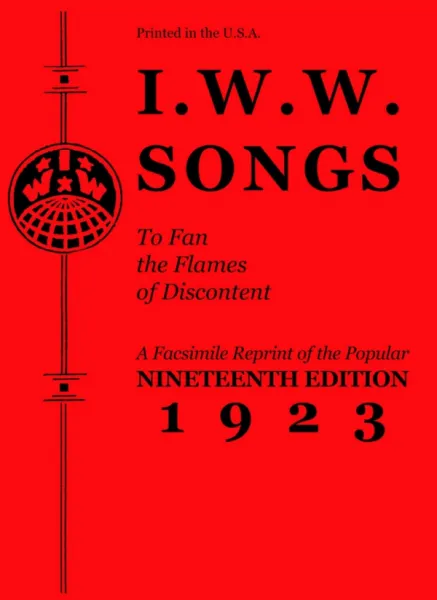
Adopting “Sing and fight!” as their rallying cry, the IWW published a pocket-size pamphlet of original and familiar labor songs, officially titled I.W.W. Songs but familiarly known as the “Little Red Songbook,” both for the color of its cover and for the IWW’s political ideology. The first printing in 1909 included fewer than 20 songs, but the IWW added new songs with each edition. By the 19th edition, printed in 1923, the collection had grown to 51 songs. (The latest edition, published by PM Press in 2016, includes over 250 songs). Many of the songs included in the songbook were reworkings of pop songs and religious hymns. “Solidarity Forever,” written in 1915 by labor activist Ralph Chaplin, took its melody from the well-known patriotic song “Battle Hymn of the Republic,” which was itself based on the Civil War anthem “John Brown’s Body” (which was itself based on the Christian camp-meeting hymn, “Say, Brothers, Will You Meet Us”), and became a popular anthem which is still sung by labor activists to this day.
But the most prolific songwriter for the IWW was the Swedish-born Joe Hill, who emigrated to the US in 1902 at age 23, became an itinerant laborer, and joined the IWW around 1910. Hill’s first song for the Wobblies, “The Preacher and the Slave,” was included in the third edition of the Little Red Songbook in 1911. A satire of the Salvation Army and other street-corner evangelists who proselytized to the poor and working class that relief from hunger and poverty would come only after they’d died and gone to heaven, “The Preacher and the Slave” was the first known use of the now-ubiquitous expression, “pie in the sky.” Like several other songwriters before him, Hill based his melody on the popular 19th century hymn, “In the Sweet By-and-By,” whose original lyrics were written by Sanford Fillmore Bennett, with its melody composed by Joseph Philbrick (“J.P.”) Webster. For Hill, the “slave” in the song’s title was not the Black antebellum slave but the common workingmen and women who were swindled and deceived by Christian preachers who conspired with factory bosses to keep the working-class submissive. Rather than viewing hymns, spirituals, and religion as an essential balm — as slaves had on the Southern plantations — the Wobblies instead sympathized with Karl Marx’s widely quoted (but routinely misconstrued) statement about religion being the opiate of the people.
Hill contributed nine more songs to the fifth edition of the Little Red Songbook, published in 1913, most notably “There is Power in a Union,” which he’d based on the camp-meeting hymn, “There is Power in the Blood,” written in 1899 by Lewis Edgar Jones. In Jones’s original chorus, the lyrics extol the spiritual salvation attained through washing oneself (metaphorically) with the blood of Jesus:
There is pow’r, pow’r, wonder-working pow’r
In the blood of the Lamb
There is pow’r, pow’r, wonder-working pow’r
In the precious blood of the Lamb
In Hill’s adaptation, salvation is instead found with the One Big Union:
There is pow’r, there is pow’r
In a band of workingmen
When they stand hand in hand
That’s a pow’r, that’s a pow’r
That must rule in every land
One Industrial Union Grand
In addition to familiar White hymns, IWW songwriters based several of their songs on Black spirituals. The melody from Hill’s “John Golden and the Lawrence Strike” — inspired by the 1912 “Bread and Roses Strike” in Lawrence, Massachusetts — was borrowed from the spiritual “A Little Talk with Jesus,” while a Wobbly songwriter using the pen name El Gato Rojo based his song “The Bosses in Slavery Hold You” on the spiritual commonly given the name “Some O’ These Days.” The original song begins with the singer’s hopeful anticipation of being baptized and born again:
I’m going down to the river of Jordan, oh yes
I’m going down to the river of Jordan, some o’ these days, hallelujah
I’m going down to the river of Jordan
I’m going down to the river of Jordan
I’m going down the river of Jordan some o’ these days
El Gato Rojo’s song, as with Hill’s “The Preacher and the Slave,” likens the non-unionized workingman to an enslaved Black person:
The bosses will in slavery hold you
The bosses will in slavery hold you (one of these days)
The bosses will in slavery hold you
If you don’t join the union one of these days
In January 1914, Hill was arrested and charged with the fatal shooting of a grocer and his teenaged son in Salt Lake City, Utah, during an attempted robbery. Hill and his supporters in the IWW maintained his innocence, declaring that the authorities were hoping to silence him and strike a blow to the radical Wobblies. That June, despite only circumstantial evidence, Hill was found guilty of murder and sentenced to death. He was killed by a firing squad on the morning of November 19, 1915. Hill quickly became a martyr and icon to the labor movement, and his songs continue to be sung by leftist activists and protesters across the world.
The practice of adapting hymns and spirituals for labor organizing survived and even extended beyond the IWW. During a 1929 strike in Marion, North Carolina, workers borrowed the arrangement from the century-old slave song “We Are Climbing Jacob’s Ladder” to sing “We Are Building a Strong Union.” Three years later, another 19th century spiritual reappeared as a labor song, during a 1931 wildcat strike by the West Virginia Mine Workers Union. Previously known as “I’ll Be All Right,” “I’ll Overcome Some Day,” or “I Shall Not be Moved,” its melody and lyrics were adapted in the 1930s as “We Shall Not be Moved,” and sung by racially mixed groups of striking miners, textile workers, and other laborers. “We Shall Not be Moved” would become a mainstay of labor activism until it would be reinvented, once again, during the Civil Rights Movement, as “We Shall Overcome.” (The thread from spirituals to Civil Rights anthems will be explored further in the next installment of this No Depression Reporting Fellowship.)
In 1929, several Black steel and ore workers in Jefferson Country, Alabama formed a capella, jubilee-quartet groups. One of these groups, composed of workers at the US Pipe and Foundry, started a group called the Sterling Jubilee Singers, who would later be renamed the CIO Singers, after receiving sponsorship from the emerging labor union that was popular among Black workers. Scholar Doug Seroff wrote in his 1985 essay, “On The Battlefield: Gospel Quartets in Jefferson County, Alabama,” that the Sterling Jubilee Singers/CIO Singers were founded “during a vibrant period when large numbers of African-American men who worked in Jefferson County’s steel mills and ore mines were forming gospel quartets…The local quartet activity had its incubation in the mining camps, company quarters, and other segregated black industrial settlements, and was in part a product of the rich fellowship that survived and was enjoyed in those oppressive environs.”
As the CIO Singers, the quartet performed regularly on local radio stations and at union functions; and, in 1952, the group recorded two quartet-influenced union songs. “The Spirit of Phil Murray” was in tribute to the recently departed first president of the United Steelworkers of America (USWA) and head of the Congress of Industrial Organizations (CIO); “Satisfied” was a curious song that links Jesus and the Last Supper to Phil Murray and the labor union:
You read in the Bible, you read it well
Listen to the story that I’m about to tell
Christ’s last Passover, He had His Communion
He told His disciples, ‘Stay in union’
Together you stand, divided you fall
Stay in union, I’ll save you all
Ever since that wonderful day, my soul’s been satisfied
Throughout the 1930s and into the 1940s, in what was the labor movement’s most active and creative era, slave hymns and spirituals continued to be reimagined as union songs. “The old spirituals were continually resurrected, especially in the South and border states like Kentucky, Tennessee, and West Virginia, as the template for protest songs,” writes Darden in Nothing but Love in God’s Water. “While northern organizers originally relied more on popular songs, the influx of southern workers — black and white — introduced more spirituals and camp-meeting songs into labor’s repertoire.”
As the labor movement continued to appropriate spirituals for its own purposes, jubilee-quartet music also continued to evolve and adapt to changing trends, incorporating elements of blues, jazz, and other secular music. The music that came to be called “gospel” would become one of the most influential and enduring musical genres ever produced in the 20th century.
The Birth of the Gospel Blues
By the end of the 1920s, a cappella, jubilee-quartet style groups like the Spirit of Memphis Quartet, the Golden Gate Quartet, and others, were in increasing competition with the secular and carnal sounds of blues music. Unlike the solo, acoustic, and male-dominated country blues of the South, the blues in the urban north typically featured large bands, swinging arrangements, and such dynamic female singers as Bessie Smith, Mamie Smith, and “the Mother of the Blues,” Ma Rainey. Blues music was looked down upon by good Christians. It was said to encourage licentiousness, wantonness, and other immoral behavior. Blues music glorified not Jesus and eternal salvation, but gambling, drinking, carousing, and idleness. Blues was — in the opinion of most church folk — “the devil’s music.” In a 1989 interview with journalist Cree McCree, the influential Detroit bluesman John Lee Hooker pushed back against this characterization: “It’s not devil music,” he said. “It’s music that’s good for the soul, that’s good for the people, it makes people happy all over the world. Just like spirituals.”
In his 1972 book, The Spirituals and the Blues, the Black liberation theologian, James. H. Cone, further acknowledged the intersection of blues and spirituals, defining blues songs as “secular spirituals,” writing:
They are secular in the sense that they confine their attention solely to the immediate and affirm the bodily expression of Black soul, including its sexual manifestations. They are spirituals because they are impelled by the same search for the truth of Black experience.
One of the most prominent musicians to exist in both the blues and spiritual domain was the songwriter, pianist, and composer Thomas Andrew Dorsey, who would take the blues directly into the church, consequently revolutionizing Black religious music and establishing a new musical genre which would come to be called “gospel.”
Born in a rural area west of Atlanta, Georgia in 1899, Dorsey learned piano at an early age and played the blues at juke joints, rent parties, and brothels in and around Atlanta. In 1919, after bouncing up and down for a few years between Chicago and Atlanta, Dorsey permanently moved to Chicago, where he soon found moderate success as a blues musician and songwriter. After hearing a mesmeric and exhilarating rendition of the Christian hymn, “I Do, Don’t You,” by a singing evangelist named W.M Nix, during Chicago’s National Baptist Convention in September 1921, Dorsey experienced what would be his first conversion experience. “My inner-being was thrilled,” Dorsey recalled in an interview years later, as reprinted in Michael W. Harris’s 1992 biography, The Rise of Gospel Blues. “My soul was a deluge of divine rapture; my emotions were aroused; my heart was inspired to become a great singer and worker in the Kingdom of the Lord — and impress people just as this great singer did that Sunday morning.”
Dorsey wrote his first religious song within a year, “If I Don’t Get There,” which was printed in 1922 in Gospel Pearls — a collection of hymns, spirituals, and jubilee songs published by the National Baptist Convention. That same year, Dorsey became the music director for the New Hope Baptist Church in Chicago, where he first began to experiment with melding blues with religious music. Dorsey’s music was, at the very least, tolerated by the congregation.
But financial needs brought Dorsey back to playing in nightclubs and writing and composing blues and dance songs, where he earned a better living than writing and playing religious songs. He soon attracted the attention of the popular — and famously bawdy — blues singer Ma Rainey, who hired Dorsey as her piano player and band leader. Dorsey had steady work and steady pay, and in August 1925 he’d married the woman he loved, Nettie Harper — “a lovely little maid from Georgia,” as described in The Rise of Gospel Blues — but by 1926 Dorsey had sunk into a deep and debilitating depression, which persisted for two years. He lost his job, ran out of money, lost weight, and contemplated suicide. Nettie was obliged to work and care for him, as he slowly wasted away. Finally, while attending a church service in 1928, the minister, Bishop H.H. Haley, took Dorsey aside and told him: “Brother Dorsey, there is no reason for you to be looking so poorly and feeling so badly. The Lord has too much work for you to do to let you die.”
Dorsey’s second conversion experience came after Haley went on to pull “a live serpent” from Dorsey’s throat, instantly curing Dorsey of his depression. “Lord,” Dorsey said to himself, “I am ready to do your work.”
Soon after this miraculous experience, Dorsey’s close friend and neighbor took ill and died suddenly and unexpectedly. Rather than sink back into depression, Dorsey instead “consecrated myself fully to God and grew stronger and stronger physically, mentally and spiritually.” His friend’s sudden death inspired Dorsey to write a new religious song, “If You See My Savior, Tell Him That You Saw Me:”
I was standing by the bedside of a neighbor
Who was just about to cross the swelling tide
And I asked him if he would do me a favor
Kindly take this message to the other side
If you see my Savior, tell Him that you saw me
When you saw me, I was on my way
You may meet some old friends who may ask about me
Tell them I am coming home someday
With its ragtime rhythm and use of dominant seventh chords, “If You See My Savior” was, in the opinion of Dorsey’s biographer, Michael W. Harris, the “first gospel blues.” For Dorsey, as with John Lee Hooker, blues and spiritual music each served to communicate a similar feeling in the listener — a “grasping of the heart,” in Dorsey’s words.
Though “gospel” had been used intermittently since the late 19th century, to describe either hymn or spiritual singing, “gospel music” hadn’t yet been coined as a distinct musical genre. Dorsey’s blues-influenced spiritual songs — first known as “Dorsey songs,” then “Dorseys” — eventually came to be known as “gospel blues,” later shortened to “gospel.” But Dorsey would disabuse the notion that he’d invented gospel music, stating that he’d only taken spiritual music and “made it beautiful, more noticeable, more susceptible with runs and trills and moans in it. That’s really one of the reasons my folk called it gospel music.”
Dorsey had been greatly influenced by the Black Methodist minister and songwriter Charles Albert Tindley, whose original compositions in the early 20th century, including “I’ll Overcome Some Day,” “What Are They Doing in Heaven (Today)?” and “Stand by Me,” were precursors to gospel music and continue to be sung today. “He was the greatest gospel songwriter — and this is not boasting — until I came along,” Dorsey told the Washington Post, Times Herald in a 1969 interview. “I tried to do what Tindley did and that went along nicely, but it began to break off. I started putting a little of the beat into gospel that we had in jazz. I also put in what we called the riff, or repetitive [rhythmic] phrases.”
On the heels of “If You See My Savior,” Dorsey printed sheet music of his gospel blues songs, which he would try to sell directly to Chicago churches and other churches across the country, only to be summarily dismissed by the congregation. “Preacher don’t want you singing no gospel,” Dorsey recalled. “The preacher’d get up there and say, ‘You can’t sing no gospel, only preach the gospel.’” Dorsey said. “I’ve been thrown out of some of the best churches in the country for that.”
Once again, Dorsey found himself struggling to make a living from religious music, and he again returned to blues and ragtime. Using the pseudonym “Georgia Tom,’ Dorsey teamed up with blues guitar player Hudson “Tampa Red” Whittaker, and the piano-guitar duo called themselves the Hokum Boys. Originating in vaudeville, “hokum” was a lively style of music distinguished by sexual innuendo, double entendre, and particularly lewd language. The Hokum Boys’ first song, “It’s Tight Like That,” released in December 1928, was an immediate hit, selling more than one million copies, and the Hokum Boys would go on to write and record over sixty songs for Vocalion and Columbia.
Dorsey continued to hopscotch between the secular and Christian worlds for a few more years. In 1931, as the Hokum Boys were still writing and recording their bawdy blues songs, Chicago’s Ebenezer Baptist Church invited Dorsey to organize a gospel chorus, which played to packed houses at churches throughout Chicago. These performances were so popular that, in February 1932, the eminent Pilgrim Baptist Church — in Chicago’s Bronzeville neighborhood — recruited Dorsey as music director (not without some grumblings from the choir director). The performances at Pilgrim Baptist Church, too, were an immediate hit, with congregants quickly becoming converted to Dorsey’s exciting new choral gospel blues. By August of that year, Dorsey co-founded what would become the National Convention of Gospel Choirs and Choruses and became its first president. But just as he was beginning to achieve national recognition and financial success as a gospel music director and composer, Dorsey’s faith would be tested in a tragic and shattering way.
On August 26, as Dorsey was in St. Louis for a series of concerts, he received the news that his wife Nellie had died while giving birth to their son. Dorsey rushed home to Chicago. The following night, his son, Thomas Andrew Dorsey, Jr., also died. Funeral services were held at Pilgrim Baptist Church. “I entered the Pilgrim Baptist Church and looked down that long aisle which led to the altar where my wife and baby lay in the same casket,” Dorsey recalled. “I started the walk in the procession and the aisle grew longer and longer before me. My legs got weak, my knees would not work right, my eyes became blind with a flood of tears.”
Dorsey might have descended again into despair, but he instead directed his grief into his music. As Harris writes in The Rise of Gospel Blues, Dorsey “sought out the gospel blues music itself as a refuge from the terror of random misfortune that seemed to stalk him and then strike at will.” One day, soon after the loss of his wife and newborn son, Dorsey was sitting at the piano, plunking out the melody of “Must Jesus Bear the Cross Alone?” — a 19th century hymn (originally titled “Maitland”) written by composer George Nelson Allen — and he wrote new lyrics to the melody, adding his own embellishments and ornamentations. He titled his new composition “Blessed Lord.” When he finished the song, he showed what he had to his musical collaborator Theodore Frye and asked for his opinion.
“No man, no,” Frye said. “Call Him ‘precious Lord.’ Don’t call him ‘blessed Lord’; call him ‘precious Lord.’”
This seemingly insignificant word swap proved pivotal. “Take My Hand, Precious Lord,” became not an acknowledgement of God’s sanctity, but a painful cry from the heart — and an intimate, deeply felt expression of trust in God’s eternal love and mercy, during the darkest night of Dorsey’s soul:
Precious Lord, take my hand
Lead me on, let me stand
I am tired, I am weak, I am worn
Through the storm, through the night
Lead me on to the light
Take my hand, Precious Lord, lead me home
“Take My Hand, Precious Lord” became Dorsey’s signature song and remains among the most popular gospel songs in the world. Emboldened by the positive reaction to “Precious Lord,” Dorsey committed himself to gospel music, personally selling his sheet music in and around Chicago, publishing his songs commercially, organizing gospel choruses, and teaching young singers how to sing this new style of music. Though he’d reached a respectable level of financial success, Dorsey was not an adept businessman, and he likely would’ve gone on hustling in Chicago’s South Side, with little upward growth, if not for an untrained but emotive singer, raised in the sanctified church, named Sallie Martin.
Martin recognized Dorsey’s talent but also saw that he didn’t know how to properly capitalize on it. “You know, you have something here,” she told Dorsey, “but you don’t know what to do with it.” Dorsey hired her as his business partner and enlisted her to help sell his music, publish and copyright his songs, assemble choirs, and travel across the country to sell his sheet music. Martin was, Dorsey admitted, “responsible for much of the success of gospel songs and singing.”
But despite her business acumen, Sallie Martin wasn’t (as she herself would admit) an especially dynamic singer. Dorsey needed a singer who could sing his songs with the fire and fervor in which he’d written them. This new music, gospel, needed a singer who could moan as well as any blues singer and shout like a holiness preacher. In 1928, when Dorsey heard a then-unknown, seventeen-year-old singer named Mahalia Jackson, he knew he’d found his singer. Together, Dorsey and Jackson would bring gospel music out of the Chicago churches and into the world — and this music would soon provide the soundtrack for the nation’s most pivotal and consequential movement for racial justice and equality.
Santi Elijah Holley is an award-winning journalist, essayist, and author of three books, including An Amerikan Family: The Shakurs and the Nation They Created, and the forthcoming Beg Borrow Steal: The Visionary Art of Melvin Van Peebles and the Rise of Independent Black Cinema. He lives in Portland, Oregon.

Comments ()