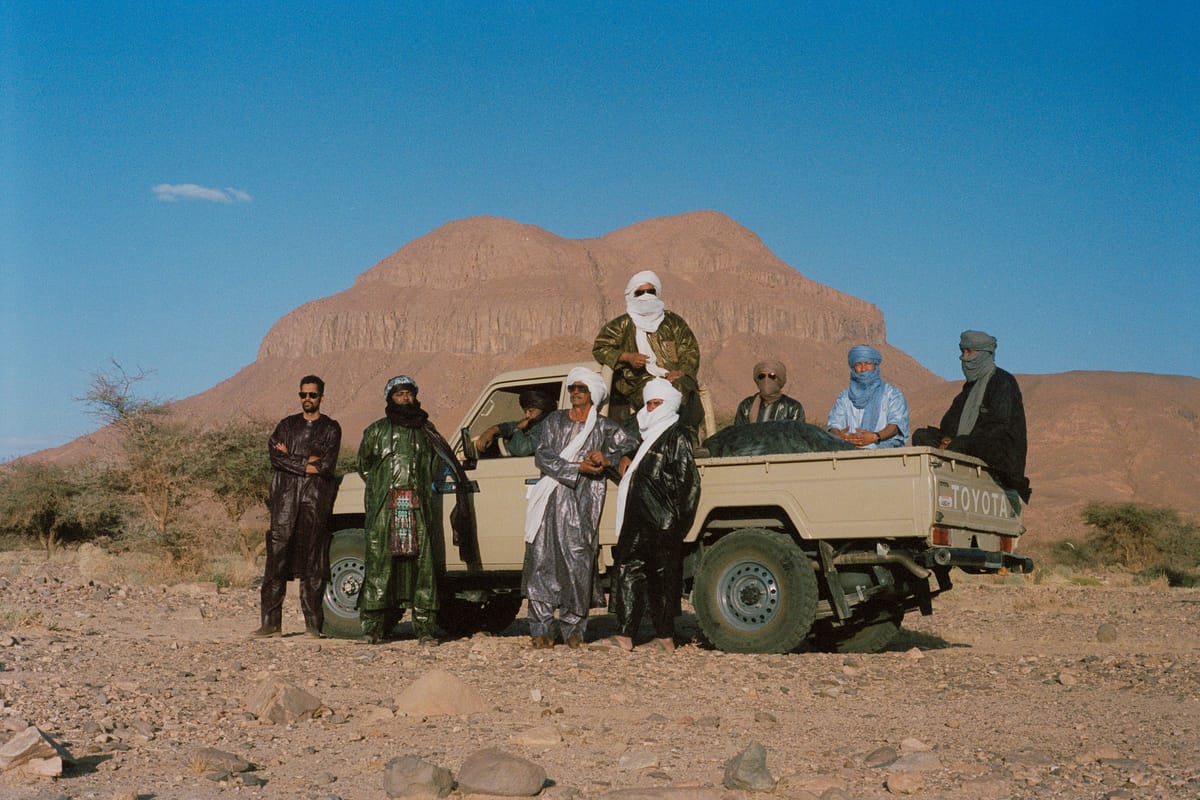
Tinariwen has been a band now for 45 years. But over the 15 years or so, the Tuareg blues-rock group out of northern and western Africa has gained global appeal, touring across their native continent, North America, Europe, Asia, and Australia. They even won the Grammy award for Best World Music Album for their 2012 album Tassili (having been nominated in 2018 and 2021, as well).
The band's 10th album, Hoggar, came out March 13 via their own label, Wedge. And like their previous work, Hoggar blends generations-old migratory and musical traditions with contemporary influences. The 11-track album sees the three original members of Tinariwen, Ibrahim Ag Alhabib, Abdallah Ag Alhousseyni, and Touhami Ag Alhassane, collaborating with members of Imarhan and Terakaft — themselves among the new generation of Tuareg musicians — and reuniting with co-founder Liya ag Ablil for the first time in 25 years.
Tinariwen has always been an inherently political band and Hoggar continues in that rich, vital tradition. Despite its meditative melodies and and polyrhythms, the band's messages — sung in their native Tamasheq — tell of struggle, dream of autonomy, and document the history of the nomadic tribes in real time. In particular, songs on Hoggar broach even more fraught topics, as “Erghad Afewo” acknowledges the division within Tuareg tribes through ironic layered vocals and the sparse, closing “Aba Malik” details the the realities in northern Mali, due to Russian mercenaries inciting violence. Like all of Tinariwen's work, it's as important to listen to the songs for how they sound, while also reading translations to understand with the songs mean.
Alhousseyni sat down with No Depression for this Q&A about the band's new album. Like other pieces in No Depression’s In The Deep End series, questions start easier then get progressively…deeper. Responses have been edited for translation, length, and clarity.
Hoggar is your 10th album! And like previous records, this one is also full of unexpected collaborations, like with Swedish (via Argentina) singer-songwriter José Gonzalez and Sudanese artist Sulafa Elyas. How did those connections come to be? And they're both singing in their native languages, right? Why was that important to maintain those voices?
We first met José González in 2012 when he opened for us in London and performed a cover of one of our songs. Since then, our managers have been trying to make a collaboration happen, and we’re happy it finally did. His gentle voice adds a new dimension to our music, something we hadn’t experienced before, and the singing in Spanish just came naturally.
![SPOTLIGHT: Cat Clyde's Grounding Rituals on the Road [ESSAY]](/content/images/size/w720/2026/03/Spotlight-Template-3.png)