Editor's Note: Annie Zaleski has been awarded one of two No Depression Criticism Fellowships to write in-depth album reviews on roots music's most important albums. Read her previous review of Gillian Welch's Time (The Revelator) here, and stay tuned for more from both No Depression Criticism Fellows all year long.
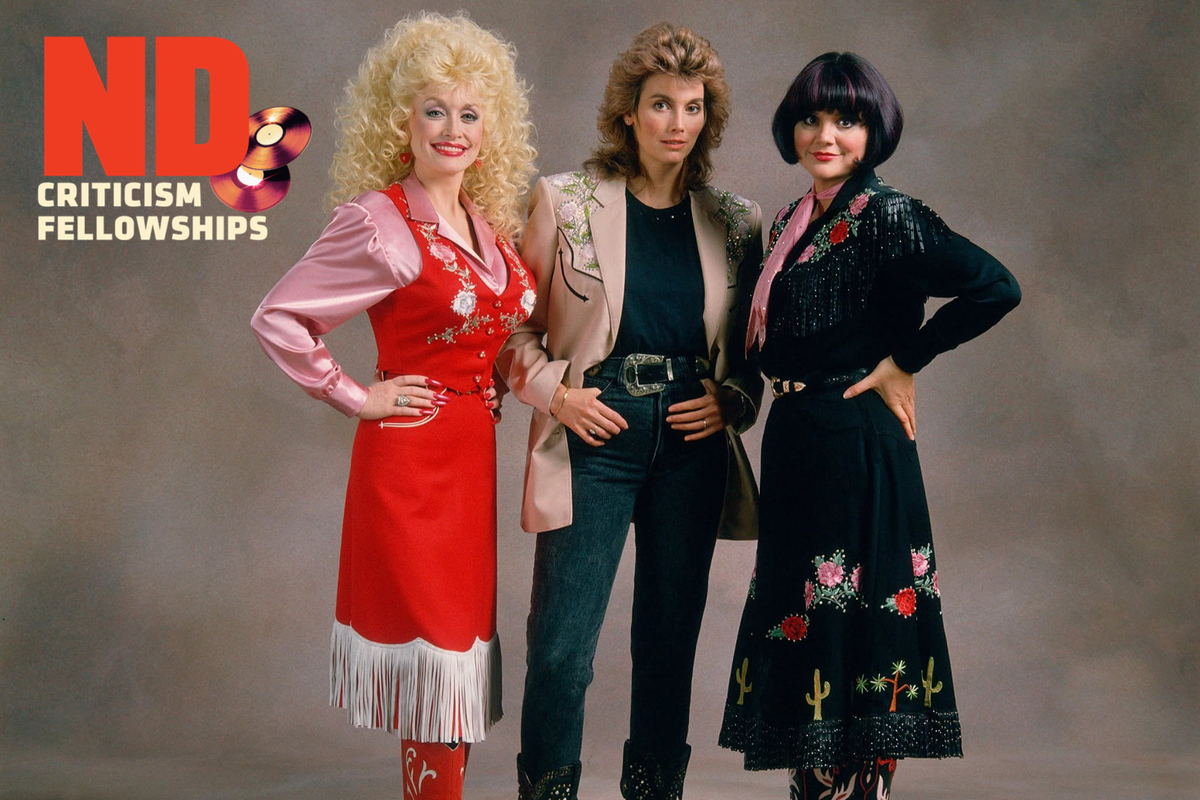
On January 19, 1986, Dolly Parton celebrated turning 40 by entering the studio with Emmylou Harris and Linda Ronstadt to record a collaborative album, Trio. “All three of us going into the studio together again was a good way to spend my birthday,” she quipped to the Detroit Free Press. That’s a vast understatement: Trio exceeded all expectations and ended up as a landmark release that encompassed country, gospel, Appalachian folk, and bluegrass.
At the point they recorded Trio, the women had traveled in the same circles for years; in fact, Ronstadt and Harris planted the seeds for the album in the 1970s with several poignant Parton covers. In 1975, the former gave “I Will Always Love You” a regal makeover, incorporating elegiac piano alongside cutting pedal steel. The latter recorded a devastatingly beautiful version of “Coat of Many Colors” that same year, imagining the song like a gentle watercolor, and cut the definitive version of “To Daddy” in 1978.
Harris, Ronstadt, and another popular artist, Maria Muldaur, also championed Parton’s late-1970s transition into pop music. “I've got them to thank for my new success," she told Sounds in 1976. "They introduced me to their audience.” The support was mutual, she added: “Of course they're trying to break into the country audience and I'm trying to push them in our circles. I'm sure the country audience would have been more familiar with them than the underground audience with me.”
Trio similarly transcends eras. While divorced from the slick production and sounds of the 1980s, the album still sounds contemporary, thanks to song selection. For example, the co-write with Linda Thompson, “Telling Me Lies,” appeared on Thompson’s 1985 One Clear Moment. The women worked with a staggering roster of A-list musicians, including Ry Cooder, Albert Lee, Herb Pedersen, and David Lindley; top-notch session players including bassists Kenny Edwards and Leland Sklar, drummer Russ Kunkel, pianist Bill Payne; and country/bluegrass musicians such as John Starling and Mark O’Connor.
As collaborators, the women also took turns in the spotlight. "We would pretty much say, 'I think Dolly would sound good on lead on this', and 'Let's try this configuration with the harmonies,’” Harris told Country Weekly in 1999. “There were never fights like, 'You're singing too many leads.' It was almost the opposite. We wanted to make sure everybody was represented, but the record was always first."
Ronstadt lends piercing lead vocals to a lovely cover of the Kate McGarrigle-penned “I’ve Had Enough,” an elegy for a broken relationship that here incorporates orchestral sweetness in the form of mournful strings and woodwinds. She also steers the heartbroken ballad “Telling Me Lies,” which is distinguished by background harmonies from Parton and Harris.
The latter is a plaintive main vocal force on “My Dear Companion,” the trio’s version of Jean Ritchie’s traditional take on an Appalachian folk song. Harris also helms the lullaby-like “To Know Him Is to Love Him,” which was originally a 1958 No. 1 pop hit for The Teddy Bears, a group featuring a then-unknown Phil Spector. (The title refers to a phrase that had been inscribed on his dad’s headstone.) Appropriately, the song is faithful to the vintage pop vibe, with Lindley contributing barely perceptible Kona Hawaiian guitar and mandolin alongside Cooder’s tremolo guitar and Lee’s acoustic contributions.
Parton’s lead vocal turns are especially delicate. On the fiddle- and mandolin-driven “Those Memories of You,” penned by Nashville Bluegrass Band lead singer Alan O’Bryant and cut by both Bill Monroe and Pam Tillis, her vocals are infused with a longing ache. And Parton wrote the buoyant folk song “Wildflowers” about herself; the song is “about a girl down there in Tennessee, wanting something, wanting more,” she said in a 1987 interview for Philip Morris magazine. “I knew there was something waiting for me, but I had to follow it to find it.” Appropriately, her voice possesses a striving, optimistic shine.